The Beatles
Hey Jude chords
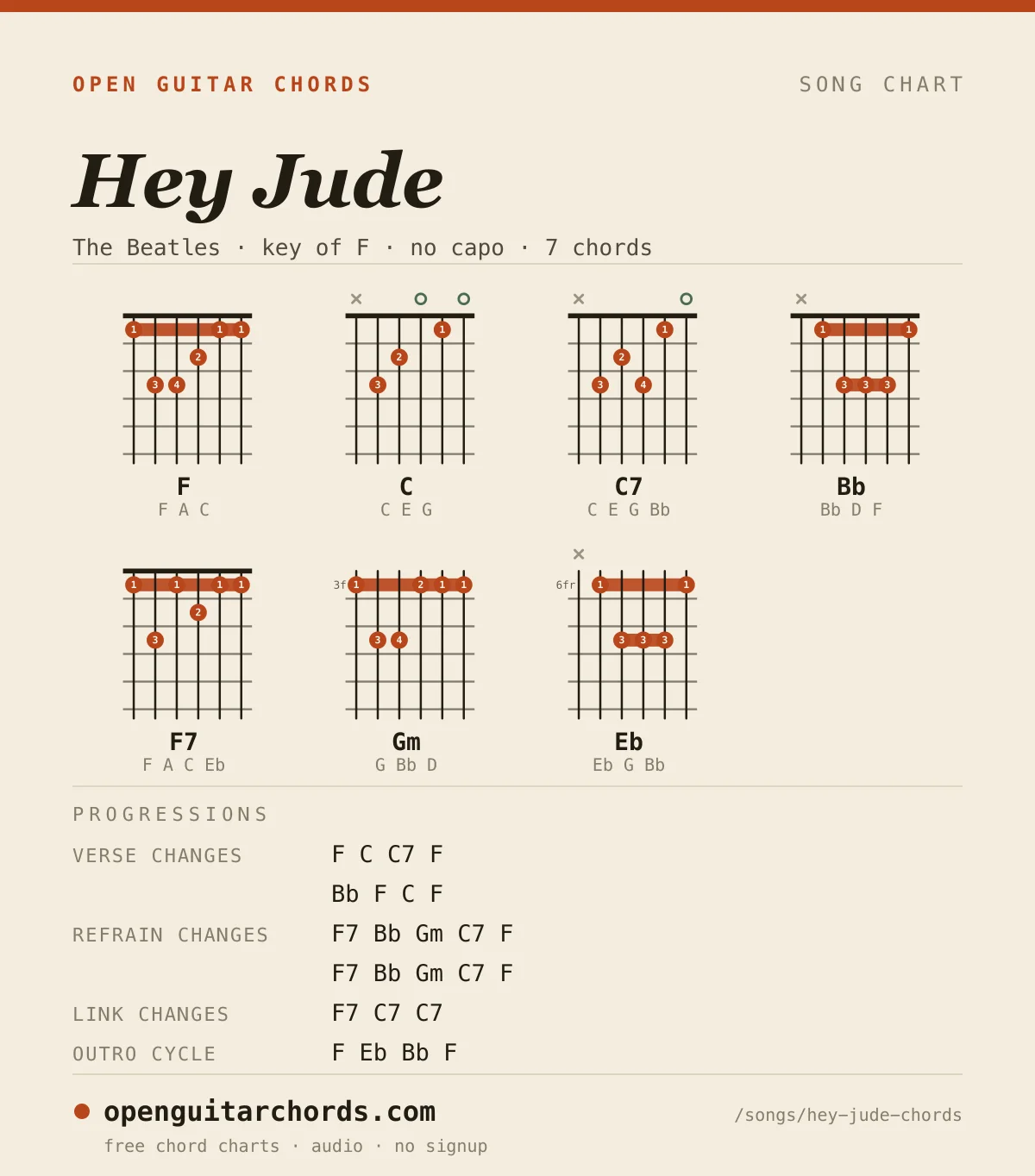
Hey Jude by The Beatles is an intermediate song in F, played with no capo. The whole sheet is 7 chords (F, C, C7, Bb, F7, Gm, Eb) across 4 sections: Verse changes → Refrain changes → Link changes → Outro cycle. 2 of the 7 shapes are open chords. Shapes that use a barre: F, Bb, F7, Gm, Eb. It sits at roughly 72 BPM.
Simplified practice arrangement. Section repetitions are practice cues rather than a verified transcription of the recording.
By Chiye · Updated
Hardest change in the sheet: Eb → Bb, once.
- Difficulty
- Intermediatebarre shape Bb
- Key
- Fwith no capo
- Tempo
- 72BPM
- Tuning
- Standard (E A D G B E)low to high
- Chords
- 72 open, 5 with a barre
- Sections
- 49 steps in the song form
Chords in Hey Jude
Frets read low E to high E, x means leave that string out.
Chord sheet
One chord per bar in this practice sheet. Follow the time signature shown beside each section; dots mark the remaining counts in the bar. Tap a bar to hear its chord, or loop the section to practise the changes.
Chord accompaniment only. Follow the section notes for this arrangement’s timing. Songs whose words are public domain →
Verse changes4/4 · ♩=72
Refrain changes4/4 · ♩=72
Link changes4/4 · ♩=72
Outro cycle4/4 · ♩=72
Printable one-page chord chart
How to play Hey Jude
Hey Jude uses F, C, C7, Bb, F7, Gm and Eb in this no-capo F-major guitar study. Work at 72 BPM, giving each displayed change four beats. Learn the verse, refrain and short link separately, then join them along the teaching route. The closing F–Eb–Bb–F cycle is a different section, so save its Eb chord for that part of the practice.
Read the F-key adaptation consistently
Lauren Bateman’s teaching chart uses D, A, A7, G, D7, Em and C shapes. This study moves that entire harmony upward three semitones to F, C, C7, Bb, F7, Gm and Eb, without a capo. If you keep the source’s D shapes instead and place a capo at fret 3, the same sounding keys correspond. Do not mix the two sets midway through a verse.
Jon MacLennan’s F-key lesson includes additional bass inversions and both Gm and Gm7. We keep the simpler harmony from the selected D-shape chart. Gm7 adds F to Gm’s G, Bb and D; it is a legitimate different colour, not a reason to relabel every Gm automatically. Compare the actual notes before borrowing a grip from another arrangement.
Separate the refrain from its short link
The verse ends its second line Bb–F–C–F. The refrain instead starts F7–Bb–Gm–C7–F and runs through that five-change group twice. Its short link is F7–C7–C7. The repeated C7 is a second counted box in the exercise, so keep time through it even though the fretting hand stays put. A repeated symbol does not mean an extra change of chord quality.
The route follows the source’s two verses, refrain and link, another verse, refrain and link, then a final verse and outro. All boxes deliberately extend each change to four beats. This lengthens shared-bar changes and leaves out the final verse’s vocal build-up; use the source when restoring sung entrances. The route locates the harmony, rather than timing every phrase of the recording.
Let F7 point toward Bb
F major contains F, A and C. Adding Eb makes F7, whose pull toward Bb gives the refrain a clear direction. In a full F grip, listen to the changed inner note when moving to F7 instead of squeezing the whole hand harder. Prepare Bb separately and aim for an even attack on its fretted notes, with the sixth string kept silent in the displayed fifth-string-root grip.
There are several barre demands here, including Gm and Eb; F is not the only hurdle. If you practise a reduced F as xx3211, keep both lower strings silent. That upper-string voicing is useful on its own, but it does not remove the other grips from the song. Rehearse F7–Bb and Bb–Gm in short pairs before linking the full refrain.
Agree on the outro ending before adding voices
The outro is F–Eb–Bb–F. Eb major contains Eb, G and Bb, while F7 contains F, A, C and Eb: sharing one note does not make them interchangeable. Hear the complete Eb chord before moving to Bb, then arrive together on F. Keep the change count audible as the singers repeat the cycle.
The teaching source marks a repeat without fixing its number. Play the displayed cycle once for study, then agree on a repeat count and a clear final signal for performance. There is no six-cycle instruction here and no attempt to encode the entire fade-out. The Beatles’ official song page credits Lennon–McCartney; John Lennon and Paul McCartney are listed as writers separately from the performing group.
How to practise Hey Jude
Four steps computed from this sheet: the order the shapes are easiest to learn in, the changes that really occur in the progressions above, where each chord turns up, and the tempo ladder up to the speed marked here.
Learn the shapes easiest first
C (x-3-2-0-1-0, beginner) → C7 (x-3-2-3-1-0, beginner) → F (1-3-3-2-1-1, intermediate, needs a barre) → F7 (1-3-1-2-1-1, intermediate, needs a barre) → Gm (3-5-5-3-3-3, intermediate, needs a barre) → Bb (x-1-3-3-3-1, intermediate, needs a barre) → Eb (x-6-8-8-8-6, intermediate, needs a barre)
2 of the 7 shapes are open chords, so start there and leave Bb until the others change cleanly.
Drill the changes this sheet actually uses
C7 → F3×Bb → F2×Bb → Gm2×F → C2×
These counts come from the progressions on this page, so they are the changes you will actually play, not a generic list of pairs to practise.
Know where each chord turns up
- FVerse changes, Refrain changes, Outro cycle
- CVerse changes
- C7Verse changes, Refrain changes, Link changes
- BbVerse changes, Refrain changes, Outro cycle
- F7Refrain changes, Link changes
- GmRefrain changes
- EbOutro cycle
Climb the tempo ladder
Start at 43 BPM and move up only when a full pass is clean: 43 → 54 → 65 → 72 BPM. The tempo marked on this sheet is 72 BPM, and the last step is the one that always feels like a jump. Stay at 65 for longer than feels necessary.
Practise each section's chord changes slowly, then play the sheet through at a steady tempo without pausing between sections.
Playing Hey Jude with a capo
This sheet needs no capo. Each card shows what you would finger at that capo position so the song still sounds exactly as written. Useful when the shapes above are awkward, or when you want to sing it higher without learning new chords.
No capoas written
F C C7 Bb F7 Gm Eb
2 of 7 stay open
Fret 1
E B B7 A E7 F#m D
5 of 7 stay open
Fret 2
Eb Bb Bb7 Ab Eb7 Fm C#
no open shapes left, all barre
Fret 3
D A A7 G D7 Em C
7 of 7 stay open
Fret 4
C# Ab Ab7 F# C#7 Ebm B
no open shapes left, all barre
Fret 5
C G G7 F C7 Dm Bb
5 of 7 stay open
Fret 6
B F# F#7 E B7 C#m A
3 of 7 stay open
Fret 7
Bb F F7 Eb Bb7 Cm Ab
no open shapes left, all barre
Working out a different key? The capo calculatordoes the same arithmetic for any chord set.
More songs built on the same chords
If Hey Jude clicks, these use the closest set of shapes, so the chords you just learned keep working.
More intermediate songs to learn after this one: Father and Son, 500 Miles, Shallow, Landslide.
These chords across the songbookHow often each chord in Hey Jude turns up across all 104 songs on this site, and what it most often moves to next. The counts come from the sheet library itself, not from theory.
114bars of this chord across the songbook
29songs use this shape
Most often followed by C, 38×.
420bars of this chord across the songbook
70songs use this shape
Most often followed by G, 115×.
12bars of this chord across the songbook
6songs use this shape
Most often followed by F, 6×.
4bars of this chord across the songbook
1songs use this shape
Most often followed by F, 2×.
7bars of this chord across the songbook
2songs use this shape
Most often followed by Bbmaj7, 4×.
2bars of this chord across the songbook
1songs use this shape
Most often followed by C7, 2×.
1bars of this chord across the songbook
1songs use this shape
Most often followed by Bb, 1×.