Conan Gray
Heather chords
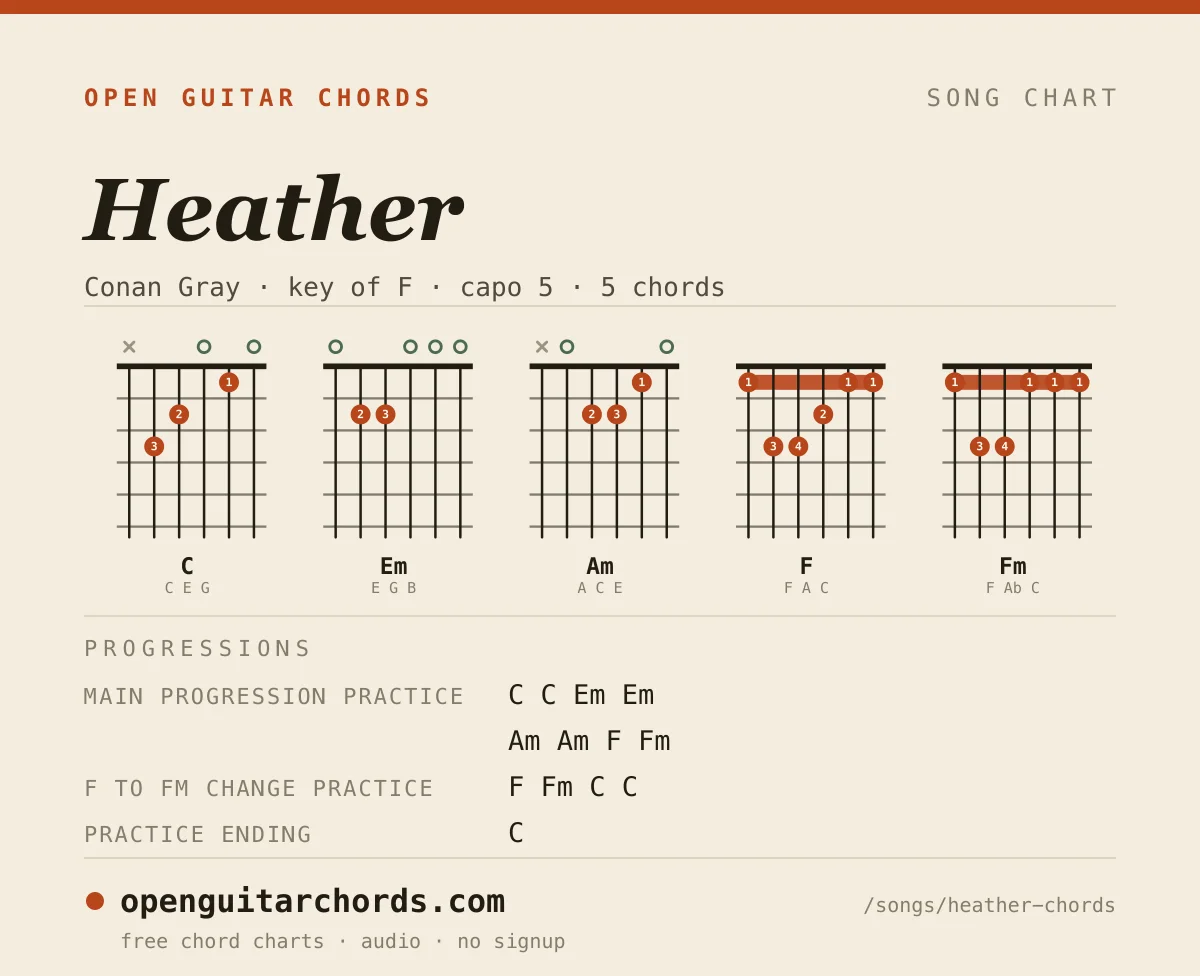
Heather by Conan Gray is an intermediate song in F, played with a capo on fret 5. The whole sheet is 5 chords (C, Em, Am, F, Fm) across 3 sections: Main progression practice → F to Fm change practice → Practice ending. 3 of the 5 shapes are open chords. Shapes that use a barre: F, Fm.
Simplified practice arrangement. Section repetitions are practice cues rather than a verified transcription of the recording.
By Chiye · Updated
Hardest change in the sheet: F → Fm, 2 times.
- Difficulty
- Intermediatebarre shape F
- Key
- Fwith a capo on fret 5
- Tuning
- Standard (E A D G B E)low to high
- Chords
- 53 open, 2 with a barre
- Sections
- 3each with its own progression
Chords in Heather
Frets read low E to high E, x means leave that string out.
Chord sheet
One chord per bar in this practice sheet. Follow the time signature shown beside each section; dots mark the remaining counts in the bar. Tap a bar to hear its chord, or loop the section to practise the changes.
Chord accompaniment only. Follow the section notes for this arrangement’s timing. Songs whose words are public domain →
Main progression practice4/4 · ♩=60
Four quarter-note downstrokes per bar; 60 BPM is a practice speed
F to Fm change practice4/4 · ♩=60
Practice ending4/4 · ♩=60
Printable one-page chord chart
How to play Heather
Play Heather with C, Em, Am, F and Fm shapes at capo 5 in standard tuning. The accompaniment sounds in F. Start with the eight-box main progression, then isolate the F-to-Fm change. These are counted guitar exercises: the section list is not the complete order of the recording, and the slower 60 BPM setting is for learning the grips.
Read capo 5 as F major
Chord symbols here describe the shapes relative to the capo. C sounds as F, Em as Am, Am as Dm, F as Bb, and Fm as Bbm. Count fret numbers from the capo, so a diagram’s first fret is the next physical fret toward the guitar body. Fit the capo close behind fret 5 and check the tuning before practising.
Taking the capo away while keeping the same shapes lowers everything by five semitones. The shape family then sounds in C rather than F. A capo change and a chord-name change are different operations: moving the capo changes pitch even when your fretting hand repeats exactly the same movement.
Follow the eight-bar practice loop
The main line is C–C–Em–Em, followed by Am–Am–F–Fm. Each box lasts a whole four-beat bar in this practice arrangement. A repeated C is a second bar of C, not an instruction to change chords halfway through the first bar. Count aloud through the holds before adding more strokes.
Begin with one quiet downstroke on each numbered beat. Keep the hand travelling between beats without catching the strings. The grid therefore alternates a downstroke and an empty eighth-note position. When Fm returns to C, start another complete loop without inserting a pause to repair the grip. If a change needs more time, lower the exercise speed instead of making the preceding bar longer.
Change from F to Fm
The catalog F is 1-3-3-2-1-1, while Fm is 1-3-3-1-1-1. Both use a first-fret barre and the same bass position. Remove the middle finger from the G string to expose the first-fret note held by the index finger. Check that this note rings; otherwise the change can look correct while its defining third stays muted.
In shape names, the third moves from A to Ab while F and C remain. At capo 5 the sounding harmony changes from Bb major to Bb minor. This is why retaining F for both bars loses something specific. Fmaj7 is another distinct chord: its added E is not part of plain F, so it should not be treated as an identical substitute either.
Keep a quiet four-beat accompaniment
Start C on the fifth string, Am on the fifth string, and let all six strings ring for Em. The full F and Fm grips printed above can use all six strings. Test each string separately before trying the loop; a clean upper string matters more than a forceful sweep.
The separate ending box asks for one downstroke on beat one and space for the rest of the bar. It is a practice stopping point. For further study, GuitarTuna’s simplified Heather chart identifies the capo and chord sequence, while Musicnotes’ piano/vocal/chords edition lists F major and 4/4. Other arrangements may regroup the pulse; use the bar count printed in the version you are following.
How to practise Heather
Four steps computed from this sheet: the order the shapes are easiest to learn in, the changes that really occur in the progressions above, where each chord turns up, and the tempo ladder up to the speed marked here.
Learn the shapes easiest first
C (x-3-2-0-1-0, beginner) → Em (0-2-2-0-0-0, beginner) → Am (x-0-2-2-1-0, beginner) → F (1-3-3-2-1-1, intermediate, needs a barre) → Fm (1-3-3-1-1-1, intermediate, needs a barre)
3 of the 5 shapes are open chords, so start there and leave F until the others change cleanly.
Drill the changes this sheet actually uses
F → Fm2×Am → F1×C → Em1×Fm → C1×
These counts come from the progressions on this page, so they are the changes you will actually play, not a generic list of pairs to practise.
Know where each chord turns up
- Cevery section
- EmMain progression practice
- AmMain progression practice
- FMain progression practice, F to Fm change practice
- FmMain progression practice, F to Fm change practice
Climb the tempo ladder
This sheet does not list a tempo, so pick one where every change is clean and use the metronome to move up in 4 BPM steps.
Practise each section's chord changes slowly, then play the sheet through at a steady tempo without pausing between sections.
Playing Heather with a capo
This sheet is written with a capo on fret 5. Each card shows what you would finger at that capo position so the song still sounds exactly as written. Useful when the shapes above are awkward, or when you want to sing it higher without learning new chords.
No capo
F Am Dm Bb Bbm
2 of 5 stay open
Fret 1
E Abm C#m A Am
3 of 5 stay open
Fret 2
Eb Gm Cm Ab Abm
no open shapes left, all barre
Fret 3
D F#m Bm G Gm
2 of 5 stay open
Fret 4
C# Fm Bbm F# F#m
no open shapes left, all barre
Fret 5as written
C Em Am F Fm
3 of 5 stay open
Fret 6
B Ebm Abm E Em
2 of 5 stay open
Fret 7
Bb Dm Gm Eb Ebm
1 of 5 stay open
Working out a different key? The capo calculatordoes the same arithmetic for any chord set.
More songs built on the same chords
If Heather clicks, these use the closest set of shapes, so the chords you just learned keep working.
More intermediate songs to learn after this one: Father and Son, 500 Miles, Shallow, Landslide.
These chords across the songbookHow often each chord in Heather turns up across all 104 songs on this site, and what it most often moves to next. The counts come from the sheet library itself, not from theory.
420bars of this chord across the songbook
70songs use this shape
Most often followed by G, 115×.
155bars of this chord across the songbook
43songs use this shape
Most often followed by C, 27×.
125bars of this chord across the songbook
35songs use this shape
Most often followed by F, 23×.
114bars of this chord across the songbook
29songs use this shape
Most often followed by C, 38×.
3bars of this chord across the songbook
2songs use this shape
Most often followed by C, 2×.