Ed Sheeran
Photograph chords
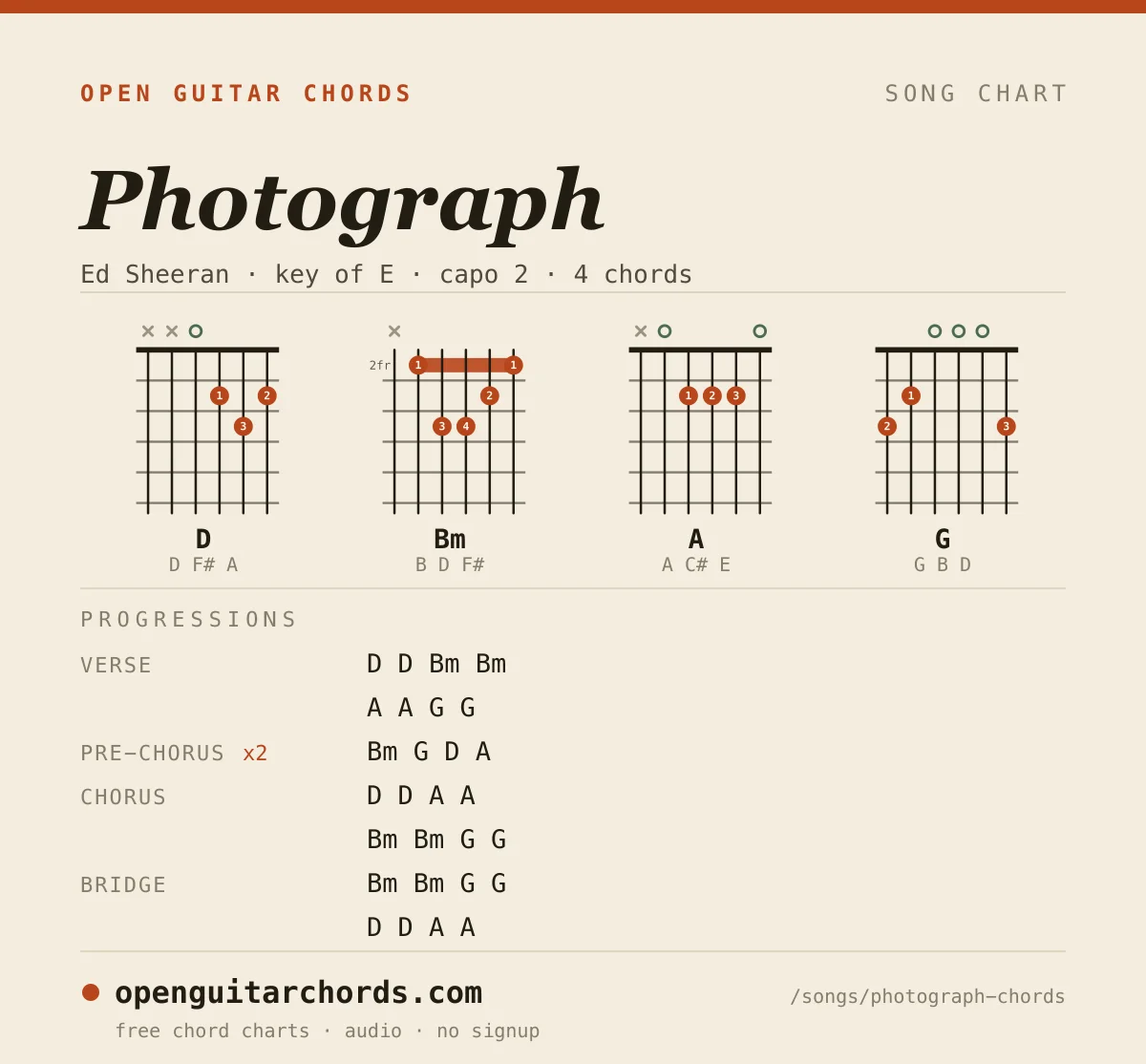
Photograph by Ed Sheeran is an intermediate song in E, played with a capo on fret 2. The whole sheet is 4 chords (D, Bm, A, G) across 4 sections: Verse → Pre-chorus ×2 → Chorus → Bridge. 3 of the 4 shapes are open chords and Bm is the one that needs a barre. It sits at roughly 108 BPM.
By Chiye · Updated
Hardest change in the sheet: Bm → G, 3 times.
- Difficulty
- Intermediatebarre shape Bm
- Key
- Ewith a capo on fret 2
- Tempo
- 108BPM
- Tuning
- Standard (E A D G B E)low to high
- Chords
- 43 open, 1 with a barre
- Sections
- 4each with its own progression
Chords in Photograph
Frets read low E to high E, x means leave that string out.
Chord sheet
One chord per bar in this practice sheet. Follow the time signature shown beside each section; dots mark the remaining counts in the bar. Tap a bar to hear its chord, or loop the section to practise the changes.
Lyrics are not reproduced for this song: they are still in copyright and this site has no licence to publish them. The chords, structure, strumming and sing-along timing are all here. Songs whose words are public domain →
Verse4/4 · ♩=108
Two bars per chord; quiet eighth-note downstrokes for this capo-2 arrangement
Pre-chorus× 2 · 4/4 · ♩=108
Chorus4/4 · ♩=108
Bridge4/4 · ♩=108
Printable one-page chord chart
How to play Photograph
Play Photograph with D, Bm, A and G shapes at capo 2. This standard-tuning arrangement sounds in E. The verse and chorus use the same chord set in different orders, while the pre-chorus changes chords twice as quickly. Use the repeated boxes to count the held chords; a second D box means another bar of D, rather than another chord to learn.
Put the capo and chord names together
The chord symbols above the boxes name the shapes you press relative to the capo. D sounds as E, Bm as C# minor, A as B, and G as A. Check the tuning after fitting the capo, especially if a tightly clamped low string has gone sharp. Keep the clamp close behind the fret and use enough pressure to stop buzzing without pulling the strings sideways.
With the capo removed, the same shapes sound a whole tone lower. To retain the E-centred pitch without a capo, use E, C#m, B and A instead. That is a different fingering choice, not a reason to move only the difficult Bm. Transpose the entire progression together when choosing a singing key.
Read the held bars before adding rhythm
The verse line is D–D–Bm–Bm followed by A–A–G–G. Each printed box lasts four quarter-note beats, giving eight bars in this practice unit. The chorus changes the order to D–D–A–A followed by Bm–Bm–G–G. Isolate the first change: the verse goes from D to Bm, while the chorus goes from D to A.
The pre-chorus uses Bm–G–D–A with one bar per chord. Its shorter holds are easy to miss after the longer verse chords. Practise just the final verse G and the first pre-chorus Bm before looping the whole section. The bridge returns to two-bar holds, starting on Bm. These are section exercises for the capo-2 arrangement, rather than a complete route through every recorded repeat and ending.
Keep the eighth-note downstrokes small
The eight D marks mean eight downstrokes per bar, counted one-and-two-and-three-and-four-and. Bring the hand back up between strokes without catching the strings. Start quietly on muted strings; a short wrist movement is easier to sustain than eight large swings. Once the motion is even, add the fretted chords without speeding up at a change.
For a softer verse, rest the edge of the picking hand lightly near the bridge. Move it a little if the strings become a dead click; the chord still needs a pitch. Release that pressure for a more open chorus. The grid gives a basic practice pulse, not every accent or plucked detail on the recording. At the displayed 108 BPM, lower the speed first if your hand tightens.
Make Bm clear before joining the loop
Our Bm diagram is x-2-4-4-3-2, with all fret numbers measured from the capo. Test each sounding string separately. A squeezed hand can still produce a muted note if another finger lies across it. Keep the first-fret gap of the shape clear and make small adjustments before adding pressure.
You can begin with x-x-4-4-3-2 and sweep only the upper four strings. Its lowest note is F#, so its bass differs from the full Bm shape, but it retains the minor harmony. Return to the full grip when you want the root in the bass.
The capo-2 chord orders and section holds follow Sébastien Corso’s Photograph teaching chart. The straight downstroke exercise is also described in JustinGuitar’s lesson; that lesson uses a different shape version. Key, meter and tempo were cross-checked with Yousician.
How to practise Photograph
Four steps computed from this sheet: the order the shapes are easiest to learn in, the changes that really occur in the progressions above, where each chord turns up, and the tempo ladder up to the recorded speed.
Learn the shapes easiest first
D (x-x-0-2-3-2, beginner) → A (x-0-2-2-2-0, beginner) → G (3-2-0-0-0-3, beginner) → Bm (x-2-4-4-3-2, intermediate, needs a barre)
3 of the 4 shapes are open chords, so start there and leave Bm until the others change cleanly.
Drill the changes this sheet actually uses
Bm → G3×D → A3×A → G1×D → Bm1×
These counts come from the progressions on this page, so they are the changes you will actually play, not a generic list of pairs to practise.
Know where each chord turns up
- Devery section
- Bmevery section
- Aevery section
- Gevery section
Climb the tempo ladder
Start at 65 BPM and move up only when a full pass is clean: 65 → 81 → 97 → 108 BPM. The recorded feel is around 108 BPM, and the last step is the one that always feels like a jump. Stay at 97 for longer than feels necessary.
Every section here uses the same set of shapes, so there is no section to single out. Whatever you can play once, you can play all the way through.
Playing Photograph with a capo
This sheet is written with a capo on fret 2. Each card shows what you would finger at that capo position so the song still sounds exactly as written. Useful when the shapes above are awkward, or when you want to sing it higher without learning new chords.
No capo
E C#m B A
2 of 4 stay open
Fret 1
Eb Cm Bb Ab
no open shapes left, all barre
Fret 2as written
D Bm A G
3 of 4 stay open
Fret 3
C# Bbm Ab F#
no open shapes left, all barre
Fret 4
C Am G F
3 of 4 stay open
Fret 5
B Abm F# E
1 of 4 stay open
Fret 6
Bb Gm F Eb
no open shapes left, all barre
Fret 7
A F#m E D
3 of 4 stay open
Working out a different key? The capo calculatordoes the same arithmetic for any chord set.
More songs built on the same chords
If Photograph clicks, these use the closest set of shapes, so the chords you just learned keep working.
More intermediate songs to learn after this one: Best Part, Hotel California, Hey Jude, Wish You Were Here.
These chords across the songbookHow often each chord in Photograph turns up across all 90 songs on this site, and what it most often moves to next. The counts come from the sheet library itself, not from theory.
274bars of this chord across the songbook
51songs use this shape
Most often followed by G, 41×.
65bars of this chord across the songbook
13songs use this shape
Most often followed by A, 14×.
132bars of this chord across the songbook
23songs use this shape
Most often followed by D, 24×.
458bars of this chord across the songbook
67songs use this shape
Most often followed by C, 80×.