Daniel Caesar feat. H.E.R.
Best Part chords
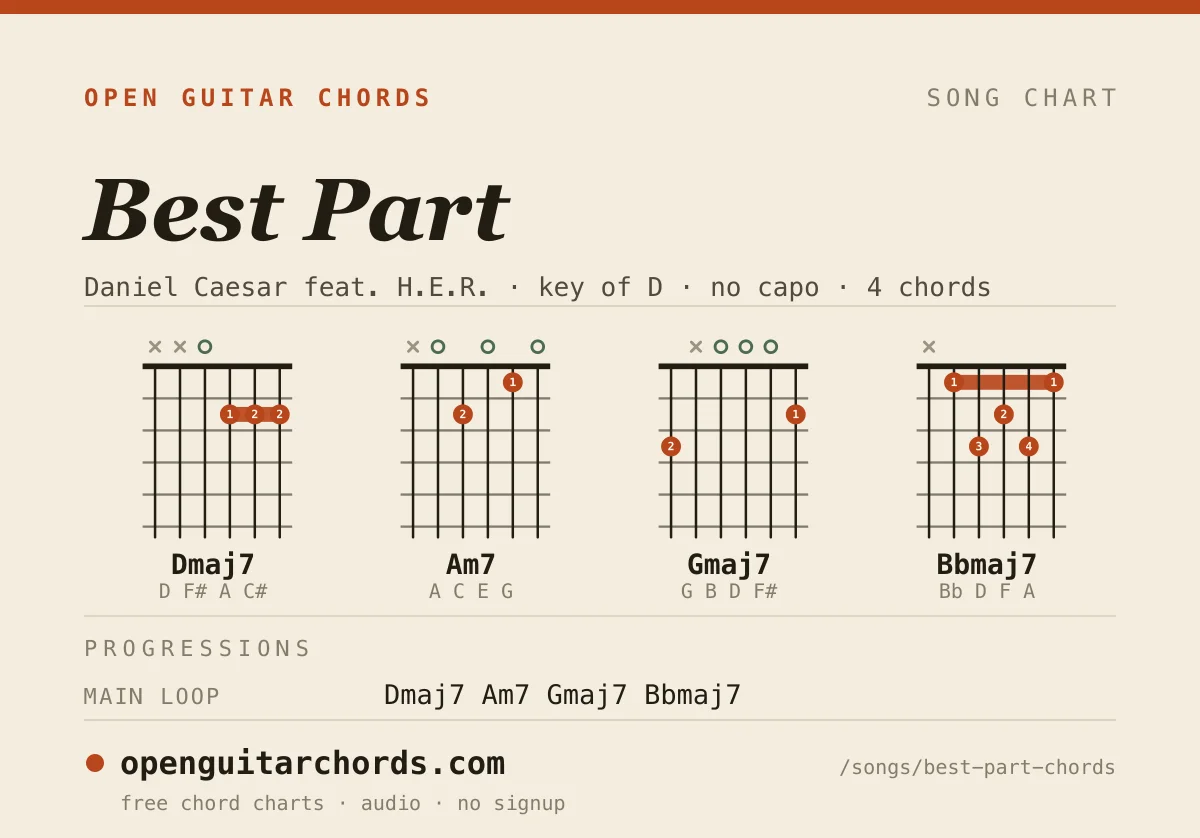
Best Part by Daniel Caesar feat. H.E.R. is an intermediate song in D, played with no capo. The whole sheet is 4 chords (Dmaj7, Am7, Gmaj7, Bbmaj7) across 1 sections: Main loop. 2 of the 4 shapes are open chords and Dmaj7 is the one that needs a barre. It sits at roughly 75 BPM.
By Chiye · Updated
Hardest change in the sheet: Dmaj7 → Am7, once.
- Difficulty
- Intermediatebarre shape Dmaj7
- Key
- Dwith no capo
- Tempo
- 75BPM
- Tuning
- Standard (E A D G B E)low to high
- Chords
- 42 open, 2 with a barre
- Sections
- 1each with its own progression
Chords in Best Part
Frets read low E to high E, x means leave that string out.
Chord sheet
One chord per bar in this practice sheet. Follow the time signature shown beside each section; dots mark the remaining counts in the bar. Tap a bar to hear its chord, or loop the section to practise the changes.
Lyrics are not reproduced for this song: they are still in copyright and this site has no licence to publish them. The chords, structure, strumming and sing-along timing are all here. Songs whose words are public domain →
Main loop4/4 · ♩=75
One bar per chord; practise the harmony first, then add your own light plucking
Printable one-page chord chart
How to play Best Part
Play Best Part with Dmaj7, Am7, Gmaj7 and Bbmaj7, using standard tuning and no capo. The chart gives you a four-bar harmony loop at 75 BPM. Each box lasts four quarter-note beats. Begin with one quiet attack per box so you can hear the colour of each chord before adding a busier accompaniment.
Read the seventh chords carefully
The small differences in these symbols matter. Dmaj7 contains D, F#, A and C#; D7 would replace C# with C. Am7 contains A, C, E and G. Gmaj7 contains G, B, D and F#, and Bbmaj7 contains Bb, D, F and A. Sound the notes slowly once, then listen to the whole chord. The seventh is part of the harmony, rather than an optional decoration to remove whenever a grip feels unfamiliar.
You can hear the change from C# in Dmaj7 to C natural in Am7. Both Am7 and Bbmaj7 contain notes outside the D major scale. Keep those symbols as written. Replacing everything with chords from one major scale would erase precisely the changes this loop lets you practise.
Use the fingerings shown on this page
Read fret strings from low E to high E, with x meaning a string you leave silent. Dmaj7 is x-x-0-2-2-2. A small barre across the top three strings can work, but keep the open fourth string clear. Am7 is x-0-2-0-1-0. Release the little barre before building that open shape; trying to slide the whole hand across can accidentally mute the open third string.
Our Gmaj7 diagram is 3-x-0-0-0-2. It leaves the fifth string silent and places the major seventh, F#, on the first string. Bbmaj7 is x-1-3-2-3-1. Check the third string separately: its second-fret A is easy to lose underneath a flattened neighbouring finger. Use only enough pressure for a clean note, then relax between attempts.
Practise the return to Dmaj7
The end of the loop deserves its own exercise. Hold Bbmaj7 for four counts, move to Dmaj7 on the next count one, and stop. Repeat that pair before running all four chords. You are moving from a first-position grip with several fretted strings to a compact shape over an open D bass. Prepare the new shape slightly above the strings rather than dragging every finger through the change.
Once each change lands reliably, loop the full line. Let your thumb or pick reach the lowest sounding string of the current grip, then add a gentle upper-string response. This is a practice accompaniment you can vary; the page does not transcribe the recording’s individual plucked notes or percussive details. Leave enough space to hear the seventh of each chord.
Change key with the whole loop
Use the transpose control to move all four symbols together, and reset before comparing fingerings with this explanation. Moving only Bbmaj7 because it feels difficult would change the progression. A capo also raises every sounding note: putting one on fret 2 while retaining these shapes produces an E-centred version rather than the D-centred version shown here.
The key, tuning, meter, tempo and chord set were checked against Yousician’s Best Part lesson. The grip checks and practice exercises above refer to this page’s diagrams.
How to practise Best Part
Four steps computed from this sheet: the order the shapes are easiest to learn in, the changes that really occur in the progressions above, where each chord turns up, and the tempo ladder up to the recorded speed.
Learn the shapes easiest first
Am7 (x-0-2-0-1-0, beginner) → Gmaj7 (3-x-0-0-0-2, beginner) → Dmaj7 (x-x-0-2-2-2, intermediate, needs a barre) → Bbmaj7 (x-1-3-2-3-1, intermediate, needs a barre)
2 of the 4 shapes are open chords, so start there and leave Dmaj7 until the others change cleanly.
Drill the changes this sheet actually uses
Am7 → Gmaj71×Dmaj7 → Am71×Gmaj7 → Bbmaj71×
These counts come from the progressions on this page, so they are the changes you will actually play, not a generic list of pairs to practise.
Know where each chord turns up
- Dmaj7every section
- Am7every section
- Gmaj7every section
- Bbmaj7every section
Climb the tempo ladder
Start at 45 BPM and move up only when a full pass is clean: 45 → 56 → 68 → 75 BPM. The recorded feel is around 75 BPM, and the last step is the one that always feels like a jump. Stay at 68 for longer than feels necessary.
Every section here uses the same set of shapes, so there is no section to single out. Whatever you can play once, you can play all the way through.
Playing Best Part with a capo
This sheet needs no capo. Each card shows what you would finger at that capo position so the song still sounds exactly as written. Useful when the shapes above are awkward, or when you want to sing it higher without learning new chords.
No capoas written
Dmaj7 Am7 Gmaj7 Bbmaj7
2 of 4 stay open
Fret 1
C#maj7 Abm7 F#maj7 Amaj7
1 of 4 stay open
Fret 2
Cmaj7 Gm7 Fmaj7 Abmaj7
2 of 4 stay open
Fret 3
Bmaj7 F#m7 Emaj7 Gmaj7
2 of 4 stay open
Fret 4
Bbmaj7 Fm7 Ebmaj7 F#maj7
no open shapes left, all barre
Fret 5
Amaj7 Em7 Dmaj7 Fmaj7
3 of 4 stay open
Fret 6
Abmaj7 Ebm7 C#maj7 Emaj7
1 of 4 stay open
Fret 7
Gmaj7 Dm7 Cmaj7 Ebmaj7
2 of 4 stay open
Working out a different key? The capo calculatordoes the same arithmetic for any chord set.
More intermediate songs to learn after this one: Photograph, Hotel California, Iris, Hey Jude.
These chords across the songbookHow often each chord in Best Part turns up across all 90 songs on this site, and what it most often moves to next. The counts come from the sheet library itself, not from theory.
1bars of this chord across the songbook
1songs use this shape
Most often followed by Am7, 1×.
11bars of this chord across the songbook
4songs use this shape
Most often followed by Dm7, 4×.
4bars of this chord across the songbook
2songs use this shape
Most often followed by C, 3×.
6bars of this chord across the songbook
2songs use this shape
Most often followed by Ebmaj7, 3×.