Gigi Perez
Sailor Song chords
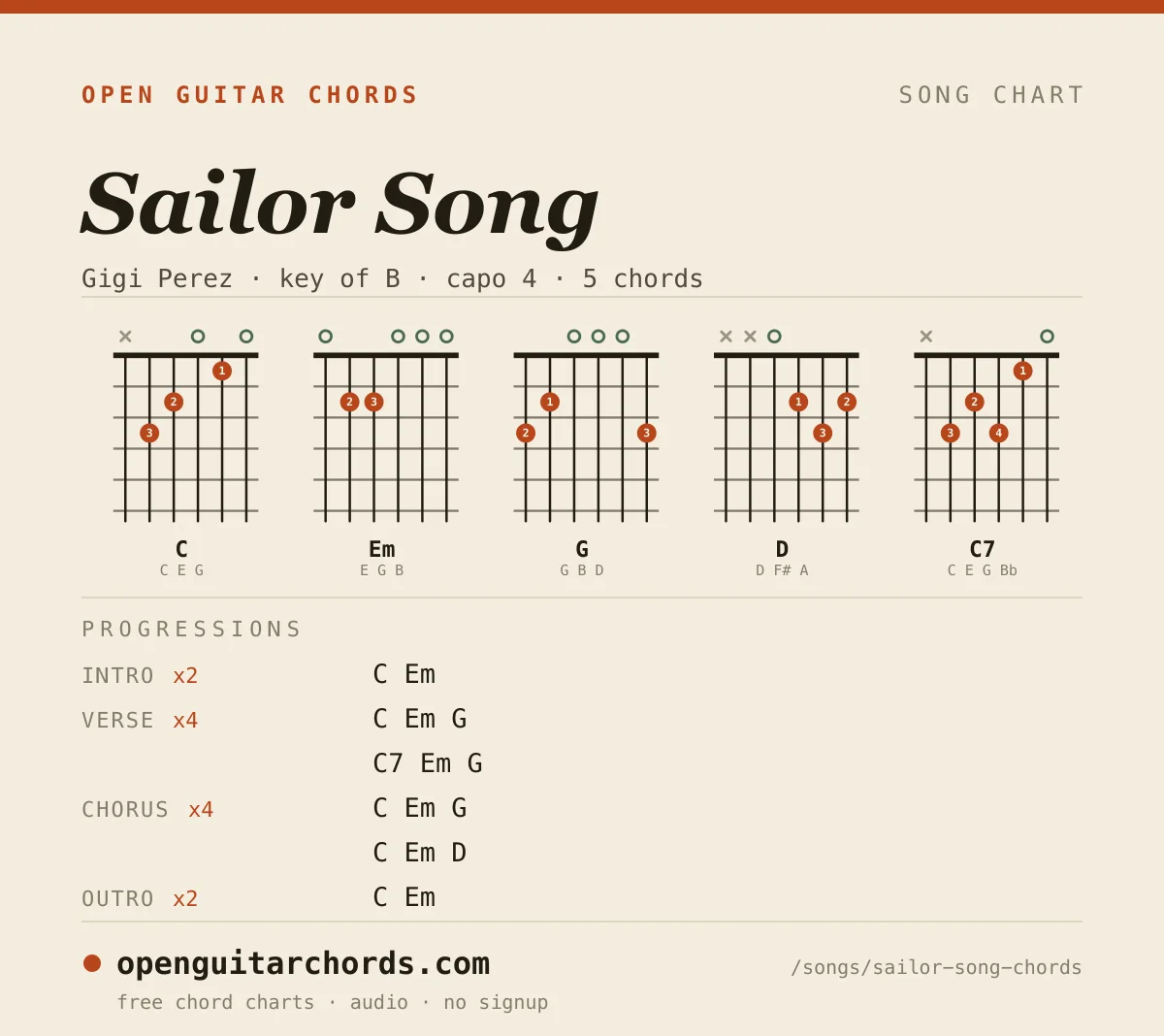
Sailor Song by Gigi Perez is a beginner song in B, played with a capo on fret 4. The whole sheet is 5 chords (C, Em, G, D, C7) across 4 sections: Intro ×2 → Verse ×4 → Chorus ×4 → Outro ×2. Every shape is an open chord, so nothing here needs barre strength. It sits at roughly 95 BPM.
By Chiye · Updated
Hardest change in the sheet: C → Em, 5 times.
- Difficulty
- Beginnerno barre needed
- Key
- Bwith a capo on fret 4
- Tempo
- 95BPM
- Tuning
- Standard (E A D G B E)low to high
- Chords
- 5all open shapes
- Sections
- 46 steps in the recorded form
Chords in Sailor Song
Frets read low E to high E, x means leave that string out.
Chord sheet
One chord per bar in this practice sheet. Follow the time signature shown beside each section; dots mark the remaining counts in the bar. Tap a bar to hear its chord, or loop the section to practise the changes.
Lyrics are not reproduced for this song: they are still in copyright and this site has no licence to publish them. The chords, structure, strumming and sing-along timing are all here. Songs whose words are public domain →
Intro× 2 · 4/4 · ♩=95
one chord per bar, let each one ring to the end
Verse× 4 · 4/4 · ♩=95
steady, nothing accentuated
Chorus× 4 · 4/4 · ♩=95
same loop, a shade louder, second ending turns around
Outro× 2 · 4/4 · ♩=95
fade on the two-chord vamp
Printable one-page chord chart
How to play Sailor Song
Three chords, one capo, and the newest chart in this library: Sailor Song loops C–Em–G at fret 4 for nearly its entire running time, which sounds as E–G♯m–B, and that is the whole song. Gigi Perez wrote and released it independently in July 2024, then reissued it on At the Beach, In Every Life for Island Records in April 2025, and the chart never grew a fourth essential chord. Beginner shapes, five sharps, one loop.
Two things make it worth practising rather than strumming once. The first is length: the cycle is three chords long, so it does not sit in fours the way most pop does. If you count a four-bar pattern over it, the harmony and your counting drift apart by the third verse and you come in wrong on a change. Count three, or count six across two loops, and the phrases land where the vocal does.
The second is that minor chord in the middle of a major key signature. In the capo-4 chart, Em is the tonic the song actually orbits, and the C shape sounds a minor sixth above it — the VI–i–III cycle that powers most of the minor-key pop you already know. The licensed sheet music calls the key B major and tab sites call it G♯m; both are describing five sharps from different ends. If you want the theory in one image, the circle of fifths puts those two names next to each other.
Most charts print plain C as the opener, and the analysis sites print a seventh. That difference is the one real choice in the song: C7 at capo 4 sounds E7, whose D♮ wants to resolve down into an A major that the song refuses to play, so the loop keeps leaning forward instead of settling. The sheet above prints both passes — plain C on the first time through a verse, C7 on the second — so you can hear which one you want without stopping to swap shapes. The D you see in the second ending is the same idea one step further: it sounds as F♯, the V chord, and it is what turns the cycle around rather than ending it.
Right hand: strumming straight works, and it is the right call for a group setting, but the song sits better with the bass note of each chord on beat one and the upper three strings brushed after it. No hammer-ons, no signature riff, nothing to imitate — which is what makes it a good first song for practising even dynamics. If you want the no-capo version, the same harmony is E7, G♯m and B and needs a barre on the minor chord, so try it after Iris, where the same shape appears in the chorus. Move the capo up or down to fit your voice and the shapes do not change at all, so check the capo calculator before you decide the song is too high.
How to practise Sailor Song
Four steps computed from this sheet: the order the shapes are easiest to learn in, the changes that really occur in the progressions above, where each chord turns up, and the tempo ladder up to the recorded speed.
Learn the shapes easiest first
C (x-3-2-0-1-0, beginner) → Em (0-2-2-0-0-0, beginner) → G (3-2-0-0-0-3, beginner) → D (x-x-0-2-3-2, beginner) → C7 (x-3-2-3-1-0, beginner)
5 of the 5 shapes are open chords, so nothing here needs barre strength yet.
Drill the changes this sheet actually uses
C → Em5×Em → G3×C7 → Em1×Em → D1×
These counts come from the progressions on this page, so they are the changes you will actually play, not a generic list of pairs to practise.
Know where each chord turns up
- Cevery section
- Emevery section
- GVerse, Chorus
- DChorus
- C7Verse
Climb the tempo ladder
Start at 57 BPM and move up only when a full pass is clean: 57 → 71 → 86 → 95 BPM. The recorded feel is around 95 BPM, and the last step is the one that always feels like a jump. Stay at 86 for longer than feels necessary.
Every section here uses the same set of shapes, so there is no section to single out. Whatever you can play once, you can play all the way through.
Playing Sailor Song with a capo
This sheet is written with a capo on fret 4. Each card shows what you would finger at that capo position so the song still sounds exactly as written. Useful when the shapes above are awkward, or when you want to sing it higher without learning new chords.
No capo
E Abm B F# E7
2 of 5 stay open
Fret 1
Eb Gm Bb F Eb7
no open shapes left, all barre
Fret 2
D F#m A E D7
4 of 5 stay open
Fret 3
C# Fm Ab Eb C#7
no open shapes left, all barre
Fret 4as written
C Em G D C7
5 of 5 stay open
Fret 5
B Ebm F# C# B7
1 of 5 stay open
Fret 6
Bb Dm F C Bb7
2 of 5 stay open
Fret 7
A C#m E B A7
3 of 5 stay open
Working out a different key? The capo calculatordoes the same arithmetic for any chord set.
More songs built on the same chords
If Sailor Song clicks, these use the closest set of shapes, so the chords you just learned keep working.
More beginner songs to learn after this one: The Scientist, 505, Linger, Teardrops on My Guitar.
These chords across the songbookHow often each chord in Sailor Song turns up across all 90 songs on this site, and what it most often moves to next. The counts come from the sheet library itself, not from theory.
384bars of this chord across the songbook
59songs use this shape
Most often followed by G, 122×.
129bars of this chord across the songbook
34songs use this shape
Most often followed by C, 30×.
458bars of this chord across the songbook
67songs use this shape
Most often followed by C, 80×.
274bars of this chord across the songbook
51songs use this shape
Most often followed by G, 41×.
10bars of this chord across the songbook
6songs use this shape
Most often followed by F, 6×.