Circle of fifths
Click any key on the wheel to see its key signature, its seven scale notes and the seven chords that belong to it.
- keys
- 12 major
- relative minors
- 12
- chords per key
- 7 diatonic
- modes
- 7 per key
Key of C major
No sharps or flats · relative minor: Am
scale notes
C - D - E - F - G - A - B
chords in this key
modes of this scale
C Ionian · D Dorian · E Phrygian · F Lydian · G Mixolydian · A Aeolian · B Locrian
keep going
Chord finder for the diagram and sound of any chord above,C major scale for the full neck map of the default key, orchord progressions for songs built from these seven chords.
How to use the wheel
The circle compresses most of practical music theory into one picture: key signatures, chord families, transposition and the reason some chord changes feel inevitable. Learn it once and every song afterwards gets easier to memorise, because you stop remembering chords and start recognising movements between them.
- Pick your key on the outer ring. The panel shows the key signature, the seven scale notes and the seven chords that belong to the key, the diatonic chords every songwriter starts from. Open any of them in thechord dictionary for the diagram.
- Use the inner ring for minor keys. Each minor key shares its notes with the major key beside it, its relative major, so the chord palette is the same and only the home chord changes. A minor and C major are the classic pair.
- Move sideways for smooth changes. Keys next to each other on the wheel differ by one note, which is why the strongest chord moves, V to I or I to IV, are always neighbours. They are also the easiest keys to transpose into, and thecapo calculator shows where to put the clamp to keep the same shapes.
- Borrow the modes for melody. The seven modes in the panel are the same seven notes started from each degree in turn. Use thescale finder to see each one mapped across the neck, then check thescale dictionary for the full write-up of that scale in that key.
What is the circle of fifths?
The circle of fifths is a wheel that arranges the twelve major keys in the order you reach them by climbing in perfect fifths: C, G, D, A, E, B, then the flat keys, then home again. Each step clockwise adds one sharp to the key signature, and each step counter-clockwise adds one flat. Because neighbouring keys differ by a single note, the wheel also shows which keys can swap into a song without a jolt. Every major key has a relative minor that shares its seven notes, and those sit on the inner ring of the same diagram. That single picture holds key signatures, the seven diatonic chords of every key, transposition and the reason some chord changes feel inevitable. Turn the wheel below and read all four answers at once, either as note names, roman numerals or the chord symbols you actually play.
Learn & referenceExamples, charts and deeper explanation
Key signatures at a glance
Key signatures come in two families, and the order of the accidentals never changes. Sharps always arrive in the order F C G D A E B; flats arrive in exactly the reverse order, B E A D G C F. Count them and you know the key.
added in this order
- 1st sharp
- F♯
- 2nd sharp
- C♯
- 3rd sharp
- G♯
- 4th sharp
- D♯
sharp keys (clockwise)
- C major
- 0 sharps
- G major
- 1 sharp
- D major
- 2 sharps
- A major
- 3 sharps
flat keys (counter-clockwise)
- F major
- 1 flat
- B♭ major
- 2 flats
- E♭ major
- 3 flats
- A♭ major
- 4 flats
Relative minors, key signatures and progressions
A relative minor sits a minor third below its major key and shares the same seven notes and the same key signature. That is why a song can feel minor while using nothing but easy open chords.
| Major key | Relative minor | Key signature | I-vi-IV-V in this key |
|---|---|---|---|
| C | Am | no sharps or flats | I-vi-IV-V in C: C Am F G |
| G | Em | 1 sharp | I-vi-IV-V in G: G Em C D |
| D | Bm | 2 sharps | I-vi-IV-V in D: D Bm G A |
| A | F#m | 3 sharps | I-vi-IV-V in A: A F#m D E |
| E | C#m | 4 sharps | I-vi-IV-V in E: E C#m A B |
| B | G#m | 5 sharps | I-vi-IV-V in B: B G#m E F# |
| F♯/G♭ | D#m | 6 sharps | I-vi-IV-V in F#: F# D#m B C# |
| D♭ | Bbm | 5 flats | I-vi-IV-V in Db: Db Bbm Gb Ab |
| A♭ | Fm | 4 flats | I-vi-IV-V in Ab: Ab Fm Db Eb |
| E♭ | Cm | 3 flats | I-vi-IV-V in Eb: Eb Cm Ab Bb |
| B♭ | Gm | 2 flats | I-vi-IV-V in Bb: Bb Gm Eb F |
| F | Dm | 1 flat | I-vi-IV-V in F: F Dm Bb C |
Relative minor pairs, and where they sit on the neck
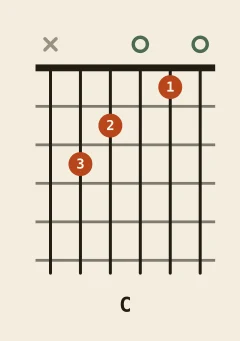
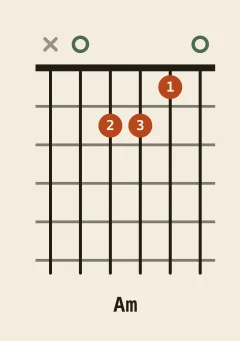
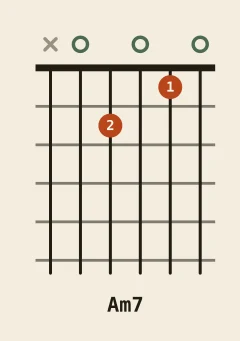
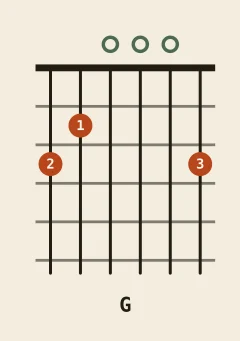
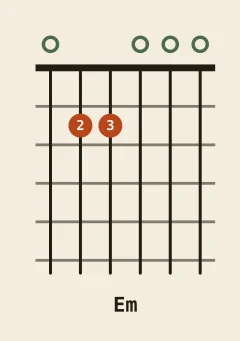
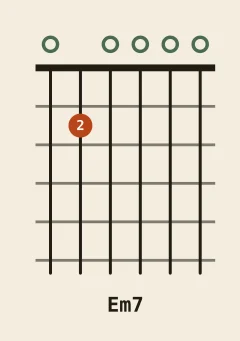
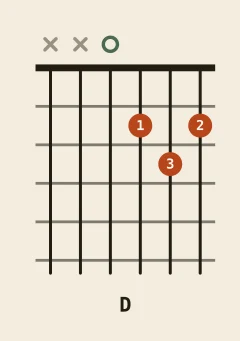
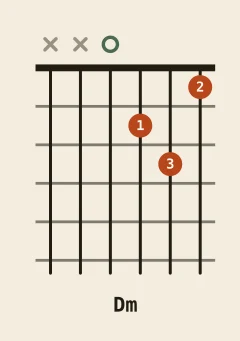
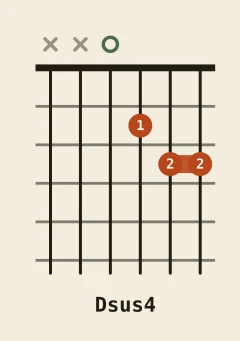
Each group below is one key family, and every chord in it is played with open strings and no barre. The tonic and its relative minor share the same seven notes, so they use the same key signature you would write at the top of the page. Open any diagram for every voicing up the neck.
Circle of fifths FAQ
What is the circle of fifths used for?
Why is it called the circle of fifths?
What do the inner-ring minor keys mean?
How do I use the wheel to write a chord progression?
New to the roman numerals in the table? Thechord progression guide and theguitar glossary explain them in plain words.