Song key finder
Enter the chords of a song and this tool tells you which key they belong to, and how well each chord fits.
- keys compared
- 24, major and minor
- chords to start
- 2
- diatonic chords
- 7 per key
- runs in
- your browser
Tap the chords in the song
Pick at least two chords. The order does not matter.
What is a song key finder?
A song key finder is a tool that works backwards from the chords in front of you. Instead of naming a key and listing its chords, it takes the chords you already found, compares them against all twelve major keys and all twelve natural minor keys, and ranks the keys by how many of your chords belong to them. Two chords usually cut the field to a few candidates, three normally settle it, and the odd chord that fits nothing is rarely a mistake: songs borrow chords from neighbouring keys all the time, and a borrowed chord is information rather than noise. The strongest single clue is position, because the first and last chord of a song is very often the tonic, so the tool treats a matching key as an answer about the song and not just about the chord set.
Learn & referenceExamples, charts and deeper explanation
Key signatures, and the chords inside each key
A key signature is the list of notes that get sharpened or flattened so the major scale comes out right. Those same accidentals decide which seven chords the key owns, and the order of qualities never changes: major, minor, minor, major, major, minor, diminished.
| Key | Key signature | The seven diatonic chords |
|---|---|---|
| C major | none | C, Dm, Em, F, G, Am, Bdim |
| G major | 1 sharp (F#) | G, Am, Bm, C, D, Em, F#dim |
| D major | 2 sharps (F#, C#) | D, Em, F#m, G, A, Bm, C#dim |
| A major | 3 sharps (F#, C#, G#) | A, Bm, C#m, D, E, F#m, G#dim |
| E major | 4 sharps (F#, C#, G#, D#) | E, F#m, G#m, A, B, C#m, D#dim |
| F major | 1 flat (Bb) | F, Gm, Am, Bb, C, Dm, Edim |
| Bb major | 2 flats (Bb, Eb) | Bb, Cm, Dm, Eb, F, Gm, Adim |
Sharps arrive in the order F, C, G, D, A, E, B and flats in the reverse order, which is why a key signature is always a prefix of that sequence. Every chord above opens from the chord dictionary.
Four chords that can only be one key
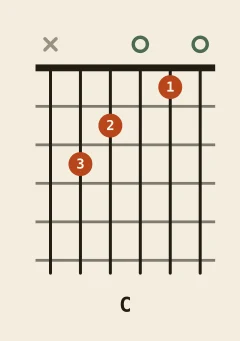
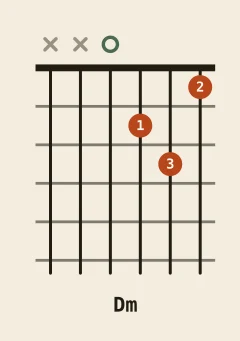
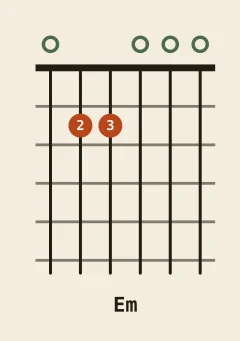
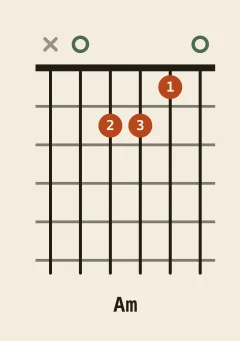
Tap C, Dm, Em and Am into the picker and no other key survives: all four are diatonic in C major, and no other major or minor family holds all four at once. These are the real fingerings, and each one is a chord page of its own.
How key finding works
Every major key owns exactly seven chords: in C major they are C, Dm, Em, F, G, Am and Bdim. When a song's chords all come from one family, that family is the key.
- Write the chords down. List every chord the song uses, in playing order where you know it. Order matters less than you expect for the first pass, but the opening and closing chords matter a lot.
- Tap two or three of them above. Two chords narrow the field to a few candidates, three normally settle it. The picker accepts sevenths as well, which is useful for blues and jazz where the V chord is played as V7.
- Read the best match, then the ties. The tool ranks the 24 keys by how many of your chords fit and shows the ones that miss. If two keys tie, the first and last chord of the song decides between them.
- Confirm at the end of the song. Play the final chord and hum the note it lands on. If that note sounds like home, the key is confirmed; if it sounds tense, try the runner-up. The circle of fifths shows the neighbouring keys that a borrowed chord usually comes from.
Relative major and minor pairs
Every major key has a relative minor three semitones below it, and the two share a key signature, so they also share all seven chords. That is why the finder always returns both sides and why a song can be described in either one.
no accidentals
- C major
- A minor
sharps
- G major
- E minor
- D major
- B minor
- A major
- F# minor
- E major
- C# minor
flats
- F major
- D minor
- Bb major
- G minor
The same pairs appear as tracks on the circle of fifths, and the scale library shows which notes each one contains.
Key finder FAQ
How do you find the key of a song from its chords?
What if the song uses a chord that is not in any key?
Major key or minor key: how do I tell?
How many chords do I need to identify a key?
Cannot name the shapes you are holding yet? The chord identifier names them from the frets, and Let It Be is a good first song to test the method on, since its sheet prints the key and every section.