Minor chord · Eb root
Ebm chord
- Eb1
- Gb♭3
- Bb5
The Eb minor chord (also called the D#m chord — same notes, different spelling) is built from the notes Eb, Gb, Bb. A minor shape you will meet in barre-chord territory.
By Chiye · Updated
What is the Ebm chord?
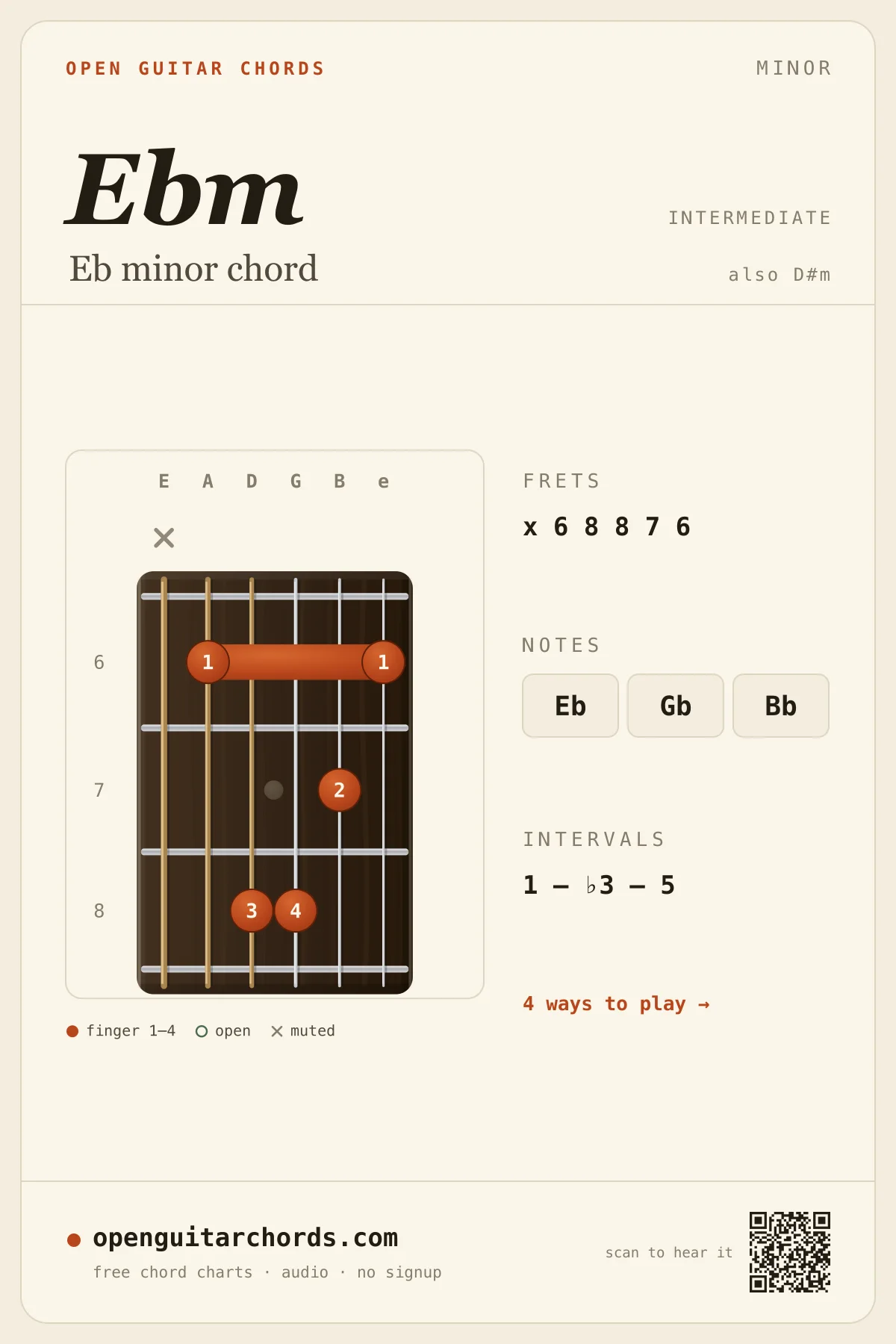
The Ebm chord (Eb minor) is a minor chord built from three notes: Eb, Gb, Bb — the 1–♭3–5 of the Eb scale, 3 semitones and 7 semitones above the root. On guitar it is most often played as a movable shape from fret 6 (x-6-8-8-7-6); shift all fretted notes together to transpose it along the neck. It is rated intermediate. The darker, moodier counterpart of the major chord. Below you will find step-by-step fingering, 4 positions up the neck, audio of every shape, and the real progressions this chord lives inside.
How do you play the Ebm chord on guitar?
Fret 6 barre — a movable shape, so this same fingering works for every root note.
- Lay your index finger flat across the A to high E strings at fret 6, rolled slightly onto its bony edge.
- Press the D string at fret 8 with your ring finger.
- Press the G string at fret 8 with your pinky finger.
- Press the B string at fret 7 with your middle finger.
- Start your strum on the A string and do not play the low E string at all.
Leave out the lowest fretted note (A string) and practise the remaining strings. The bass changes, and the upper strings may still need a smaller barre; check that the third and other colour tones stay clear. x-x-8-8-7-6
How do you make Ebm sound clean?
At the 6th fret the barre feels easy, so players press harder than needed and let the middle finger lie flat across the second string. That string carries the Gb, the minor third of Ebm.
Build Ebm from the top four strings first (8-8-7-6), then add the index barre on the fifth string. Root and colour arrive separately, which is why the shape stays clean.
In real songs
Ebm in songs
None of the 90 songs charted on this site use Ebm yet — it is a colour chord rather than a songwriting staple.
What other ways can you play Ebm up the neck?
3 more positions below. These are the same notes in a different part of the neck. Choosing the position closest to the chord you just played is what stops your hand jumping between changes.
Position 2 · Fret 1
Every note here is fretted, which means the shape transposes anywhere on the neck without changing your fingers.
Position 3 · Fret 8
Because nothing rings open, you can move this whole shape to any fret and it keeps the same quality — only the letter name changes.
Up at fret 8 the frets are close together, so use a lighter touch than you would in the open position — squeezing here pulls the notes sharp.
Position 4 · Fret 11 barre
Every note here is fretted, which means the shape transposes anywhere on the neck without changing your fingers.
The barre is the only hard part of this shape. Keep the bar finger straight and use the weight of your arm rather than the grip of your thumb.
The theory behind Ebm
Ebm is spelled Eb – Gb – Bb — the 1 – ♭3 – 5 of the Eb scale, which is the root plus 3 semitones, 7 semitones. The darker, moodier counterpart of the major chord.
The flattened third is what makes it minor, so if Ebm sounds wrong the third is almost always the note being muted — check the string carrying it before you change anything else.
What key is the Ebm chord in?
Ebm is the i chord in Eb minor, the ii chord in Db major and the vi chord in F# major — the three keys where Ebm appears naturally.
the home chord of the minor key
the gentle predominant — often before the V
the relative minor — the major key’s shadow
Ebm on other instruments
Eb – Gb – Bb — the highlighted black keys are the sharps or flats; play each note once, then move them into one hand position.
Take it to the practice room