Strumming patterns
See each pattern beat by beat, hear it played on a real C chord, then loop it until your hand stops thinking.
- patterns
- 8, beginner to advanced
- grid
- 8 eighth notes per bar
- demo chord
- C major
- audio
- Web Audio
↓ down · ↑ up · × muted chuck · · rest. One box per eighth note, so eight boxes make one bar of 4/4.
The pattern library
Four on the floor
Steady quarter-note pulse, the first pattern everyone learns. Heard in: Countless slow songs and practice sessions.
The island strum
Down, down-up, up-down-up: the most famous strum in pop. Heard in: Folk-pop, campfire songs, most 4/4 strummers.
Folk drive
Relentless forward motion with an upstroke lilt. Heard in: Country roads, protest songs, busking.
Ballad sway
Sparse and breathing, so it leaves room for the vocal. Heard in: Slow songs, waltz-feel pop in 4/4.
Country boom-chick
Bass-note down, muted chick: the boom-chick alternation. Heard in: Country, rockabilly, Johnny Cash.
Syncopated push
Accents fall between the beats, the push that makes pop groove. Heard in: Acoustic pop, R&B-influenced strumming.
Reggae offbeat
Muted chops on the offbeats: everything lands on the "and". Heard in: Reggae, ska, three-little-birds feel.
Funk sixteenths
Sixteenth-note grid with muted chucks filling the gaps. Heard in: Funk, disco rhythm guitar.
What is a strumming pattern?
A strumming pattern is the rhythm your strumming hand repeats while the fretting hand holds the chords. It decides which beats get a downstroke, which get an upstroke, and which are left silent or choked, and it is written here on a grid of eight eighth notes: one 4/4 bar, counted one and two and three and four and. Two rules make the grid readable. The first is that the hand never stops moving, so a dot in a box means the hand keeps swinging and misses the strings rather than pausing. The second is that downstrokes land on the numbered beats and upstrokes fall on the "and" in between, which is why almost every pattern alternates down and up even when only a few boxes sound. The chords supply the harmony, and the pattern supplies the groove, so the same four chords can be a ballad or a funk vamp.
Learn & referenceExamples, charts and deeper explanation
The three chords to practise these patterns on
Every demo above is strummed on an open C chord, with upstrokes catching only the top three strings. Add G and E minor and you have the shapes behind most of the songs these patterns come from.
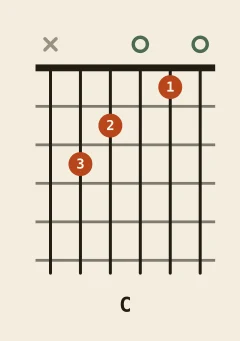
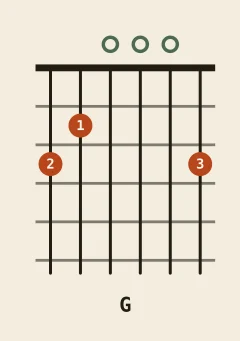
Counting a bar: beat names and grid positions
The small number under each box in the cards above is the count. Numbered boxes are the four beats of the bar; the boxes marked & are the eighth notes between them, which players call the offbeats or the "and" of the beat.
| Box | Count aloud | Stroke | Beat type | What the hand does |
|---|---|---|---|---|
| 1 | one | D | downbeat | The hand falls through the strings on the beat. |
| 2 | and | U | offbeat | The hand returns upward, often catching only the top strings. |
| 3 | two | D | downbeat | Second pulse of the bar, the same motion as box 1. |
| 4 | and | U | offbeat | The eighth note between two and three. |
| 5 | three | D | downbeat | The halfway point of the bar. |
| 6 | and | U | offbeat | The eighth note between three and four. |
| 7 | four | D | downbeat | The last downbeat, and often where the chord change lands. |
| 8 | and | U | offbeat | Leads back into box 1, which is the start of the next bar. |
What the four grid symbols mean
| Symbol | Name | What it tells your strumming hand |
|---|---|---|
| D | downstroke | A sweep down across the strings, from the low E towards the floor. |
| U | upstroke | A sweep back up, which usually catches only the top three or four strings. |
| × | muted chuck | The fretting hand relaxes onto the strings so the stroke clicks instead of ringing. |
| · | rest | The hand keeps swinging but misses the strings. The motion never stops. |
How to practice a strumming pattern
- Mute and loop. Rest your fretting fingers across the strings without pressing, and play the pattern as pure rhythm: clicks only. The strumming hand never stops moving, and rests are just swings that miss the strings.
- Add one chord, then the metronome. Loop the pattern on a single easy chord (C or G) at 60 BPM. Speed up only when it is effortless. The metronome is the referee.
- Count out loud. Say the grid as you play: one, and, two, and, three, and, four, and. Counting turns a row of boxes into a rhythm you can hear, and it stops rests from turning into pauses.
- Put it in a song. Every sheet in the songbook names its strumming feel, so you can match it to a pattern here. Wonderwall prints its own strumming line (D D U U D U), and Three Little Birds describes the offbeat skank of the reggae pattern above.
Strumming patterns FAQ
What is a strumming pattern?
How do I learn a new strumming pattern?
What do the arrows mean?
How do I find the strumming pattern of a song?
What tempo should I practise a strumming pattern at?
Playing a pattern that will not sit still? Check the chords first in the chord dictionary, or slow the loop down with the metronome until the changes are automatic.