Online guitar tuner
Tune an acoustic or electric guitar in the browser. Let the microphone guide each string, or switch to manual and tune by ear.
- tuning
- E A D G B E
- notes
- 82.41-329.63 Hz
- in tune
- within 5 cents
- audio
- browser only
·
Click start and allow the microphone. Your audio never leaves this device.
Which order should I tune the strings in?
Work thick to thin. The low strings carry the most tension, so changing one moves the others slightly; tuning them first means you only have to correct the thin strings once.
- Start on the low E string. Pluck it gently over the middle of the neck and tune it to E2 at 82.41 Hz. Every other string is measured against the note this one produces, so getting it right first saves a second pass.
- Walk up to the A string. Tune A2 at 110.00 Hz, then D3 at 146.83 Hz. Fretting the 5th fret of the low E gives you the A you are aiming for, so you can check the reading by ear before you trust the needle.
- Mind the G to B gap. After G3 at 196.00 Hz, the next string is B3 at 246.94 Hz. That pair is a major third apart rather than a fourth, so the 5th fret trick becomes the 4th fret: the 4th fret of the G string sounds the open B.
- Finish on the high e. Tune E4 at 329.63 Hz, exactly two octaves above the low E, then strum all six strings open and listen for the slow beating that means one pair is still slightly apart.
- Tune up, not down. If a string reads sharp, loosen it below the note and bring it back up to pitch. Approaching from below keeps the peg gears under tension, so the string holds far longer once you stop.
Four chords that tell you the tuning is right
A tuned guitar should make these four shapes ring clean. If one string buzzes or sounds sour inside a chord, the open string alone may still have read in tune: check it again while you hold the shape.
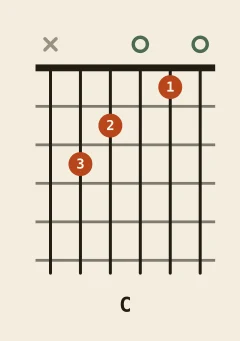
What is an online guitar tuner?
An online guitar tuner is a page that listens to your guitar and tells you whether each string is sharp, flat or in tune. This one uses the microphone as a pitch detector: it measures the frequency of whichever string is ringing, then matches that frequency to the closest of the six standard tuning notes E2, A2, D3, G3, B3 and E4. The needle shows how far away you are in cents, and a string turns terracotta once you are within five cents, which is about as close as the ear can reliably hear. Manual mode does the same job by ear instead: tap a string to hear its reference pitch and turn the peg until the two agree. Nothing is recorded, nothing is uploaded, and no plugin or app is involved, so the same page works on a phone propped against the case.
Learn & referenceExamples, charts and deeper explanation
Standard tuning, string by string
Standard tuning is the reference every chord chart on this site assumes. These are the six open strings with their frequencies in equal temperament at A4 = 440 Hz, from the thickest string to the thinnest.
| String | Tuned to | Note | Frequency | How it sits in the tuning |
|---|---|---|---|---|
| 6th | low E | E2 | 82.41 Hz | the thickest string, and the reference for everything else |
| 5th | A | A2 | 110.00 Hz | a perfect fourth (5 semitones) above low E |
| 4th | D | D3 | 146.83 Hz | a perfect fourth above A |
| 3rd | G | G3 | 196.00 Hz | a perfect fourth above D |
| 2nd | B | B3 | 246.94 Hz | a major third above G, the one wider gap in the tuning |
| 1st | high e | E4 | 329.63 Hz | a perfect fourth above B, two octaves above the low E |
For a different reference, see the online metronome to hold a steady pulse while you tune, or the beginner chord guide for the shapes that standard tuning makes easy.
Accuracy, range, and what the tuner listens for
reading
- Strings matched
- E2 A2 D3 G3 B3 E4
- Frequency range
- 60-1400 Hz
- Display
- ±50 cents
- In tune
- within 5 cents
- Detector
- autocorrelation
tuning by ear
- Reference
- A4 = 440 Hz
- Low E
- 82.41 Hz
- High e
- 329.63 Hz
- Modes
- mic and manual
browser
- Microphone
- live analysis
- Recording
- none
- Upload
- none
- Download
- none
- Signup
- none
The needle reads cents, not hertz, because a cent is the same musical distance at every pitch: one hundredth of a semitone. Being 10 cents sharp on the low E and 10 cents sharp on the high e is the same error to the ear, even though the number of hertz involved is four times larger on the thin string. Five cents is the usual limit of what most players can hear in a chord, so that is the threshold the needle treats as settled.
Alternate tunings you can check with the same needle
The microphone matches whatever note is actually sounding, so it does not care that you have retuned the guitar. These are the four retunings players reach for most, with the string that moves.
| Tuning | Low to high | What changes |
|---|---|---|
| Drop D | D A D G B E | the 6th string drops a whole tone to D, so power chords become one finger |
| Half step down | Eb Ab Db Gb Bb Eb | every string drops a semitone, the common tuning for vocal-friendly keys |
| DADGAD | D A D G A D | the 2nd string drops a tone and the 1st drops a fourth, a modal, droning sound |
| Open G | D G D G B D | the 6th, 5th and 1st strings retune, and strumming all six gives a G chord |