Online metronome
A steady click for practice. Tap the tempo in, dial the BPM, and hear the downbeat accented so you always know where the one is.
- range
- 20-300 BPM
- tap tempo
- 2 taps or more
- signatures
- 2/4 3/4 4/4 6/8
- audio
- Web Audio
The loop most people start with
Learn the changes at 60 BPM first, one bar each, with the click on every beat. C, G, Am and F is the most common four-chord loop in pop, and it exercises every kind of change: down a fourth, up a sixth, and the barre chord everyone avoids.
How to use this metronome
Timing is the skill listeners notice first, before tone and before speed. The click turns "steady" from a feeling into a fact: either you are on it or you are not.
- Set the tempo. Type a BPM, drag the slider, or tap the tempo you hear in your head. Slower is better: 60 to 80 BPM is where real practice happens.
- Pick the time signature. 4/4 for almost everything, 3/4 for waltzes, 6/8 for ballads with a rolling feel. The first beat of every bar is accented higher so you can feel the one.
- Play on the click, then between the clicks. Start exactly on each beat. When that is easy, halve the BPM and treat each click as beats two and four. That is the classic way to build an internal clock.
- Log the number. Write down the tempo you can actually play cleanly today. Progress on a metronome is measured in single BPM, not in how fast it felt once.
What is an online metronome?
An online metronome is a steady audible pulse at a tempo you set, measured in beats per minute. This one runs entirely in your browser with the Web Audio API, so it starts instantly, downloads nothing, and keeps time with the audio clock rather than a video or an app. Type a BPM, drag the slider, or tap the tempo of the song in your head and the page measures the gaps between your taps to work out the number for you. Four time signatures cover almost everything you will practise, with the first beat of every bar accented higher so you can always feel where the one is. It also doubles as a tempo finder: when you know a track is 128 BPM, you can slow it to 70 percent and practise the changes at a speed your hands can actually manage. Set it slower than feels comfortable, play until the passage is clean three times in a row, then move the tempo up.
Learn & referenceExamples, charts and deeper explanation
Tempo markings, and what they mean in BPM
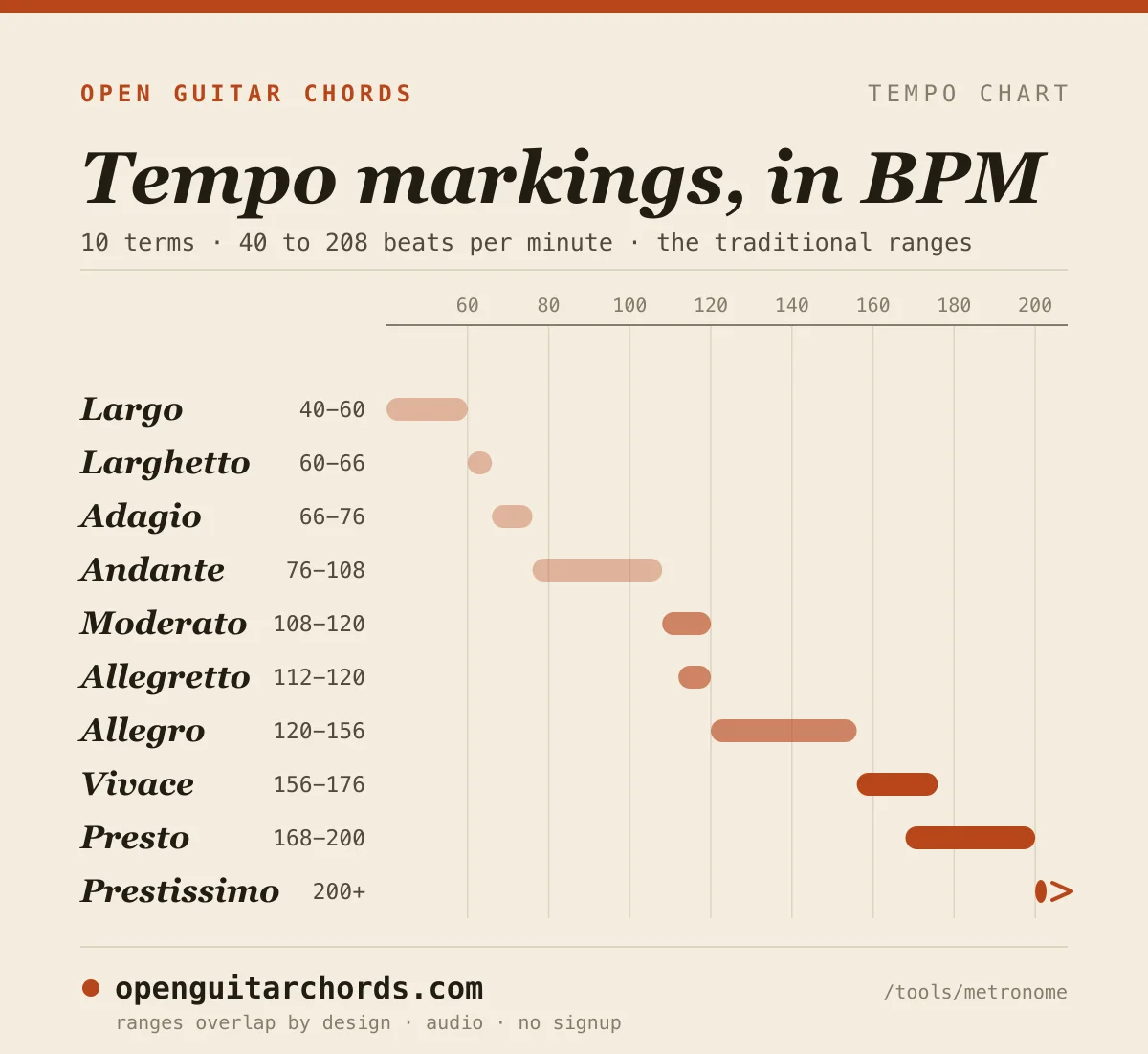
Sheet music rarely prints a number. It prints an Italian word, and the word is a range rather than a single tempo. These are the traditional ranges, so you can translate a marking into something you can dial in.
slow
- Largo
- 40-60
- Larghetto
- 60-66
- Adagio
- 66-76
- Andante
- 76-108
moderate
- Moderato
- 108-120
- Allegretto
- 112-120
- Allegro
- 120-156
fast
- Vivace
- 156-176
- Presto
- 168-200
- Prestissimo
- 200+
Time signatures, and when to use them
| Signature | Count it | Where you meet it |
|---|---|---|
| 4/4 | 1 2 3 4 | Almost all pop, rock, blues and country. The default, and the accent lands on beat one of every bar. |
| 3/4 | 1 2 3 | Waltzes and most ballads in three, from Blue Danube to Christmas carols. |
| 2/4 | 1 2 | Marches, polkas and fast pop where the bar feels like a left-right pair. |
| 6/8 | 1 2 3 4 5 6 | Blues shuffles and rolling ballads. Feel it as two big beats, each split into three. |