Vance Joy
Riptide chords
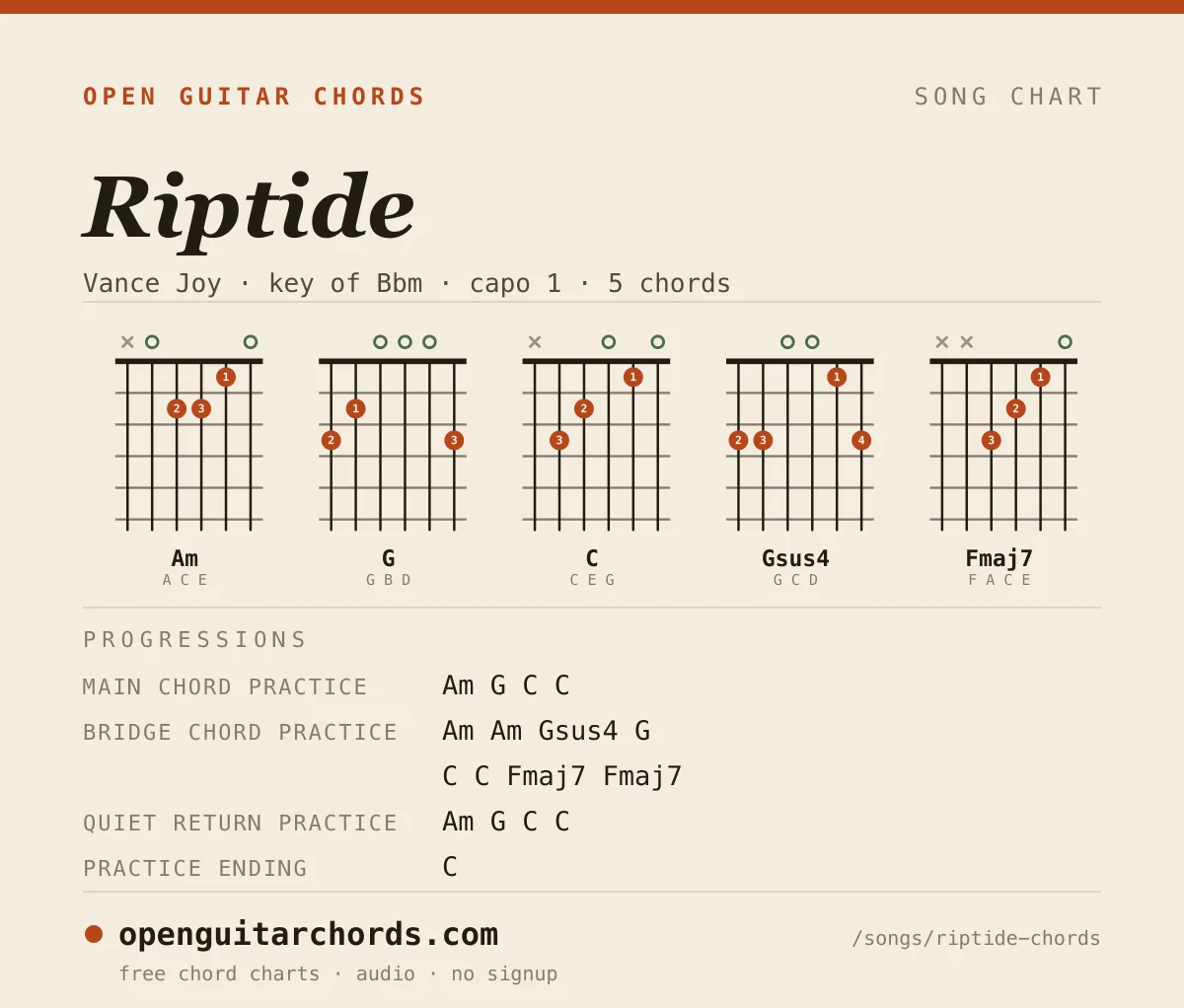
Riptide by Vance Joy is a beginner song in Bbm, played with a capo on fret 1. The whole sheet is 5 chords (Am, G, C, Gsus4, Fmaj7) across 4 sections: Main chord practice → Bridge chord practice → Quiet return practice → Practice ending. Every shape is an open chord, so nothing here needs barre strength.
Simplified practice arrangement. Section repetitions are practice cues rather than a verified transcription of the recording.
By Chiye · Updated
Hardest change in the sheet: Am → G, 2 times.
- Difficulty
- Beginnerno barre needed
- Key
- Bbmwith a capo on fret 1
- Tuning
- Standard (E A D G B E)low to high
- Chords
- 5all open shapes
- Sections
- 4each with its own progression
Chords in Riptide
Frets read low E to high E, x means leave that string out.
Chord sheet
One chord per bar in this practice sheet. Follow the time signature shown beside each section; dots mark the remaining counts in the bar. Tap a bar to hear its chord, or loop the section to practise the changes.
Chord accompaniment only. Follow the section notes for this arrangement’s timing. Songs whose words are public domain →
Main chord practice4/4 · ♩=72
Bridge chord practice4/4 · ♩=72
Quiet return practice4/4 · ♩=72
Practice ending4/4 · ♩=72
Printable one-page chord chart
How to play Riptide
Play Riptide using Am, G and C shapes with capo 1 in standard tuning. The bridge exercise adds Gsus4 and Fmaj7. Begin with the chord changes, then use the eight-slot strumming grid at 72 BPM. These are slow guitar exercises with a full four-beat bar for every box; the repeated boxes and section list are not a transcription of the recording’s exact timing.
Set up the guitar version at capo 1
Place the capo close behind fret 1 and check each string. Am sounds as Bbm, G as Ab and C as Db. The bridge shapes Gsus4 and Fmaj7 become Absus4 and Gbmaj7. The diagrams are relative to the capo: fret 1 in a diagram means the next physical fret toward the body, rather than the fret already occupied by the capo.
Modern Guitar Tuition’s quick guide distinguishes the capo-1 original-pitch setup from a no-capo cover. Keep the instrument and version clear when comparing charts. A ukulele fingering is not a six-string guitar diagram, even when both pages print Am. Removing this guitar capo while retaining the shapes lowers every note by a semitone; it does not leave the accompaniment at the same pitch.
Count the practice grid without stopping the hand
Count one-and-two-and-three-and-four-and. D . D U . U D U places downstrokes on 1, 2 and 4, with upstrokes after 2, 3 and 4. On the empty positions, let the hand continue travelling without touching the strings. Keeping that motion makes the upstroke after beat 3 easier to place.
The main exercise uses one bar each of Am and G, followed by two bars of C. These holds deliberately give the hand time to learn the pattern. First mute the strings and practise one complete bar repeatedly. Then add Am only, then the changes. If the left hand misses a landing, continue counting rather than inserting a pause that hides where the beat went.
Add the suspended chord in the bridge
The bridge exercise is Am–Am–Gsus4–G, then C–C–Fmaj7–Fmaj7. This chord order comes from JustinGuitar’s guitar lesson; each entry receives a full bar in our slower exercise. Gsus4 contains C where G contains B. Hear that change as you return to G rather than treating the two symbols as interchangeable labels.
For Fmaj7, use x-x-3-2-1-0 and start the sweep on string 4. The open high E is its major seventh. Plain F does not contain that note, while Fm changes a different note altogether. A narrow four-string sweep keeps the two unwanted bass strings out. Practise C to Fmaj7 without rhythm first, checking the first string remains open instead of being accidentally muted by the index finger.
Use the quiet return to control the dynamics
The quiet-return exercise gives one downstroke on beat 1 of each box. Let the other beats pass while the chord rings. Follow it with the main strumming exercise and compare the volume: more strokes need not mean hitting every string harder. Keep the lighter upstrokes on the thinner strings so the accompaniment leaves room for a voice.
C and Am share B-string fret 1 and D-string fret 2, making them a useful isolated pair. G and Am do not share a fretted B-string note in the printed grips, so do not pin a finger there while changing. Finish on C with a single downstroke. For the complete performance and its shorter changes, follow one selected recording or published chart instead of multiplying these practice boxes into a supposed full song.
How to practise Riptide
Four steps computed from this sheet: the order the shapes are easiest to learn in, the changes that really occur in the progressions above, where each chord turns up, and the tempo ladder up to the speed marked here.
Learn the shapes easiest first
Am (x-0-2-2-1-0, beginner) → G (3-2-0-0-0-3, beginner) → C (x-3-2-0-1-0, beginner) → Gsus4 (3-3-0-0-1-3, beginner) → Fmaj7 (x-x-3-2-1-0, beginner)
5 of the 5 shapes are open chords, so nothing here needs barre strength yet.
Drill the changes this sheet actually uses
Am → G2×G → C2×Am → Gsus41×C → Fmaj71×
These counts come from the progressions on this page, so they are the changes you will actually play, not a generic list of pairs to practise.
Know where each chord turns up
- AmMain chord practice, Bridge chord practice, Quiet return practice
- GMain chord practice, Bridge chord practice, Quiet return practice
- Cevery section
- Gsus4Bridge chord practice
- Fmaj7Bridge chord practice
Climb the tempo ladder
This sheet does not list a tempo, so pick one where every change is clean and use the metronome to move up in 4 BPM steps.
Practise each section's chord changes slowly, then play the sheet through at a steady tempo without pausing between sections.
Playing Riptide with a capo
This sheet is written with a capo on fret 1. Each card shows what you would finger at that capo position so the song still sounds exactly as written. Useful when the shapes above are awkward, or when you want to sing it higher without learning new chords.
No capo
Bbm Ab C# Absus4 F#maj7
no open shapes left, all barre
Fret 1as written
Am G C Gsus4 Fmaj7
5 of 5 stay open
Fret 2
Abm F# B F#sus4 Emaj7
no open shapes left, all barre
Fret 3
Gm F Bb Fsus4 Ebmaj7
no open shapes left, all barre
Fret 4
F#m E A Esus4 Dmaj7
3 of 5 stay open
Fret 5
Fm Eb Ab Ebsus4 C#maj7
no open shapes left, all barre
Fret 6
Em D G Dsus4 Cmaj7
4 of 5 stay open
Fret 7
Ebm C# F# C#sus4 Bmaj7
no open shapes left, all barre
Working out a different key? The capo calculatordoes the same arithmetic for any chord set.
More songs built on the same chords
If Riptide clicks, these use the closest set of shapes, so the chords you just learned keep working.
More beginner songs to learn after this one: Sweater Weather, Payphone, 505, Linger.
These chords across the songbookHow often each chord in Riptide turns up across all 104 songs on this site, and what it most often moves to next. The counts come from the sheet library itself, not from theory.
125bars of this chord across the songbook
35songs use this shape
Most often followed by F, 23×.
509bars of this chord across the songbook
77songs use this shape
Most often followed by D, 89×.
420bars of this chord across the songbook
70songs use this shape
Most often followed by G, 115×.
1bars of this chord across the songbook
1songs use this shape
Most often followed by G, 1×.
15bars of this chord across the songbook
5songs use this shape
Most often followed by C, 4×.