Bob Dylan
Knockin' on Heaven's Door chords
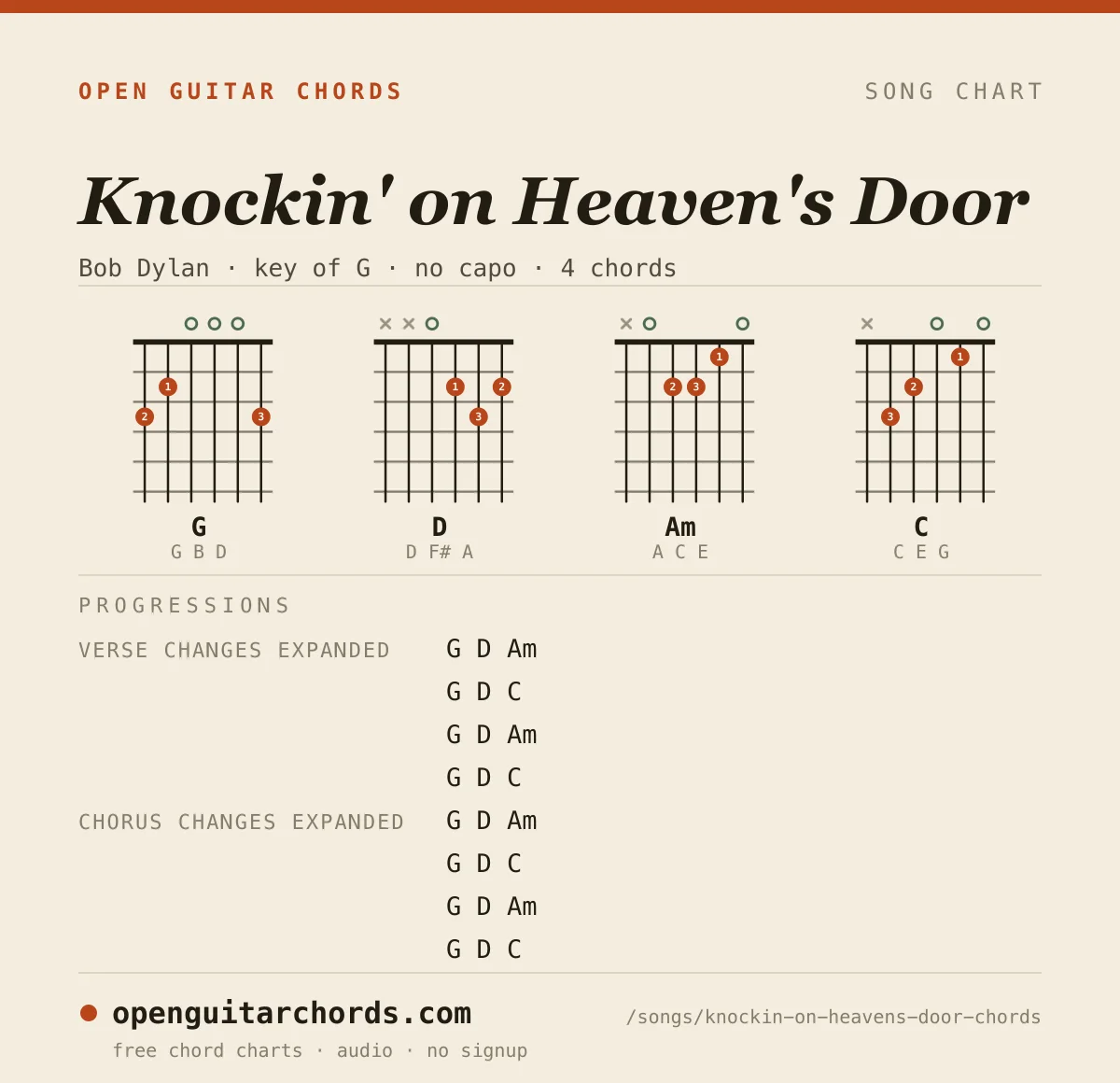
Knockin' on Heaven's Door by Bob Dylan is a beginner song in G, played with no capo. The whole sheet is 4 chords (G, D, Am, C) across 2 sections: Verse changes expanded → Chorus changes expanded. Every shape is an open chord, so nothing here needs barre strength. It sits at roughly 70 BPM.
Simplified practice arrangement. Section repetitions are practice cues rather than a verified transcription of the recording.
By Chiye · Updated
Hardest change in the sheet: G → D, 8 times.
- Difficulty
- Beginnerno barre needed
- Key
- Gwith no capo
- Tempo
- 70BPM
- Tuning
- Standard (E A D G B E)low to high
- Chords
- 4all open shapes
- Sections
- 24 steps in the song form
Chords in Knockin' on Heaven's Door
Frets read low E to high E, x means leave that string out.
Chord sheet
One chord per bar in this practice sheet. Follow the time signature shown beside each section; dots mark the remaining counts in the bar. Tap a bar to hear its chord, or loop the section to practise the changes.
Chord accompaniment only. Follow the section notes for this arrangement’s timing. Songs whose words are public domain →
Verse changes expanded4/4 · ♩=70
Chorus changes expanded4/4 · ♩=70
Printable one-page chord chart
How to play Knockin' on Heaven's Door
Knockin’ on Heaven’s Door uses G, D, Am and C in standard tuning, without a capo. This Bob Dylan chord study uses a 70 BPM practice pulse and two related changes: G–D–Am, then G–D–C. Every box here lasts four beats. In the source chart G and D move twice as quickly, so learn the fingers from these boxes and restore the shorter changes separately.
Give G and D the right share of the source bar
Lauren Bateman’s teaching chart gives G two beats and D two beats in the same bar. Am fills the next bar. The next pair follows the same timing, with C replacing Am. That makes a four-bar source cycle, even though six chord names occur within it. Six names do not automatically mean six bars.
This page deliberately stretches G and D to a full four beats each. A practice cycle therefore has six boxes and six bars. Count all four beats before changing, including the spaces between the four downstrokes. When you return to the source timing, put G on beat one, D on beat three and Am or C on the next first beat. Change the durations together rather than shortening whichever chord happens to feel easiest.
Keep two fingers in place between Am and C
The displayed Am is x-0-2-2-1-0, while C is x-3-2-0-1-0. Your index finger stays on the B string at fret 1 and the middle finger stays on the D string at fret 2. Move the ring finger from the G string at fret 2 to the A string at fret 3. Let the G string open as you arrive at C.
Sound the fifth string first in both grips and leave the sixth string silent. Check that the moving finger does not flatten against the open string beside it. Practise that movement with one quiet stroke on each arrival before returning to the full cycle. Keeping the two shared fingers down can help, but do not grip so hard that the hand cannot pivot comfortably.
Change the picking range as well as the left hand
G can use all six strings. D starts on the open fourth string, leaving the lower E and A strings out. Am and C both start on the fifth string. A clean change therefore includes a small adjustment of where the strum begins. A perfectly formed D can still sound unclear if the low E is struck beneath it.
The four-downstroke grid is a plain coordination exercise. Use a small movement and keep every numbered beat equally spaced before adding accents. Lauren’s fuller alternatives include a finer subdivision; they have not been squeezed into an eight-cell grid. Keep the printed practice rhythm intact while learning the grips, then study the source pattern with its own count.
Follow a teaching route rather than guessing repeats
The route follows the two verses and two choruses in Lauren’s chart. Each displayed section contains two practice cycles. Their identical harmony does not supply an intro, a solo or an independently verified recording ending. The previous three-repeat verse instruction has been removed because that repeat count was not supported by the selected route.
Bob Dylan’s official song page identifies Dylan as the writer. Keep his song separate from later performance arrangements when choosing a tuning, tempo or ending. Finish a complete practice section before stopping the loop; after the grips become reliable, restore the source’s two-beat G-to-D change instead of trying to sing against the deliberately lengthened boxes.
How to practise Knockin' on Heaven's Door
Four steps computed from this sheet: the order the shapes are easiest to learn in, the changes that really occur in the progressions above, where each chord turns up, and the tempo ladder up to the speed marked here.
Learn the shapes easiest first
G (3-2-0-0-0-3, beginner) → D (x-x-0-2-3-2, beginner) → Am (x-0-2-2-1-0, beginner) → C (x-3-2-0-1-0, beginner)
4 of the 4 shapes are open chords, so nothing here needs barre strength yet.
Drill the changes this sheet actually uses
G → D8×D → Am4×D → C4×
These counts come from the progressions on this page, so they are the changes you will actually play, not a generic list of pairs to practise.
Know where each chord turns up
- Gevery section
- Devery section
- Amevery section
- Cevery section
Climb the tempo ladder
Start at 42 BPM and move up only when a full pass is clean: 42 → 53 → 63 → 70 BPM. The tempo marked on this sheet is 70 BPM, and the last step is the one that always feels like a jump. Stay at 63 for longer than feels necessary.
Practise each section's chord changes slowly, then play the sheet through at a steady tempo without pausing between sections.
Playing Knockin' on Heaven's Door with a capo
This sheet needs no capo. Each card shows what you would finger at that capo position so the song still sounds exactly as written. Useful when the shapes above are awkward, or when you want to sing it higher without learning new chords.
No capoas written
G D Am C
4 of 4 stay open
Fret 1
F# C# Abm B
no open shapes left, all barre
Fret 2
F C Gm Bb
1 of 4 stay open
Fret 3
E B F#m A
2 of 4 stay open
Fret 4
Eb Bb Fm Ab
no open shapes left, all barre
Fret 5
D A Em G
4 of 4 stay open
Fret 6
C# Ab Ebm F#
no open shapes left, all barre
Fret 7
C G Dm F
3 of 4 stay open
Working out a different key? The capo calculatordoes the same arithmetic for any chord set.
More songs built on the same chords
If Knockin' on Heaven's Door clicks, these use the closest set of shapes, so the chords you just learned keep working.
More beginner songs to learn after this one: Payphone, The Scientist, 505, Linger.
These chords across the songbookHow often each chord in Knockin' on Heaven's Door turns up across all 104 songs on this site, and what it most often moves to next. The counts come from the sheet library itself, not from theory.
509bars of this chord across the songbook
77songs use this shape
Most often followed by D, 89×.
323bars of this chord across the songbook
58songs use this shape
Most often followed by G, 52×.
125bars of this chord across the songbook
35songs use this shape
Most often followed by F, 23×.
420bars of this chord across the songbook
70songs use this shape
Most often followed by G, 115×.