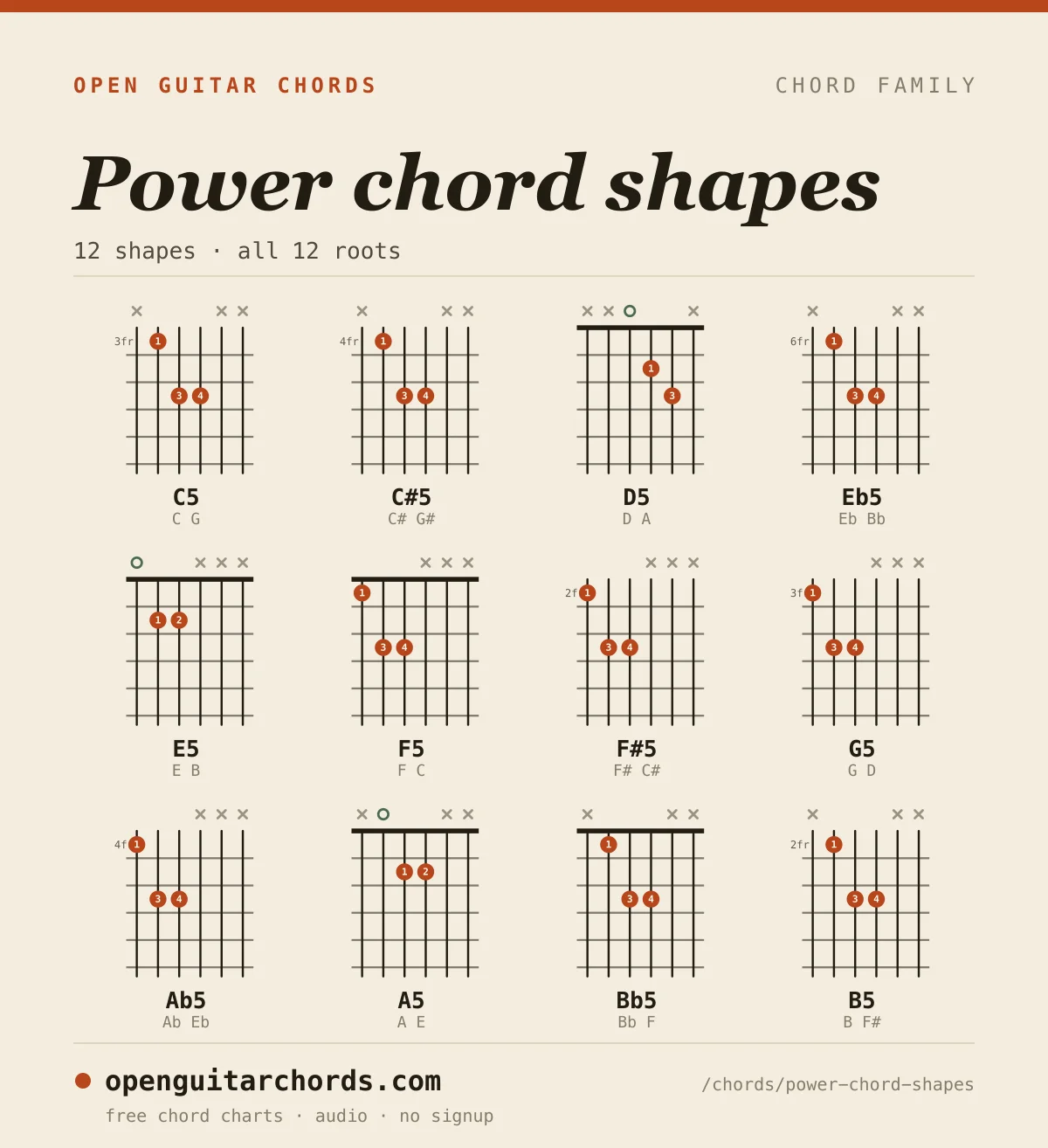
Chord family · 12 shapes
Power chord shapes
A power chord is a root and a fifth — sometimes doubled at the octave, and sometimes with the root added on top. There is no third anywhere in it, which is why it is neither major nor minor and why it survives huge amounts of distortion without turning to mud.
One movable shape covers all twelve roots: put your index on the root, your ring finger two frets up on the next string, and mute everything else. Slide it anywhere and the chord name changes while the shape stays identical.
Power Chord
12 shapesHow to use power chord shapes in a song
Two notes or three is an arrangement decision, not a difficulty one. The three-note version adds the root an octave higher on the next string, which gives a rhythm part more body without adding any harmonic colour. The two-note version cuts through a dense mix better and leaves room for a second guitar.
Where power chords go wrong is muting. The strings between and around the shape have to be silenced with the edges of your fretting hand and the heel of your palm, or the distortion turns every extra string into mush. Practise the shape with the gain turned off first, so you can hear what is ringing when it should not be.
Because a power chord carries no major-or-minor information, you can play one shape through a song that originally had six chords and it never sounds wrong. That is why punk and metal arrangements convert whole progressions this way, and it is the fastest route to playing a song you already know at twice the tempo.
Three of the 12 shapes here are open-position and nine are movable. The movable ones are the point: one hand position plus a count up the low strings gives you every root, which is why this is usually the first family an electric player learns.
If you only try two of the shapes on this page, try C5 and C#5: both can be reached from shapes you already know, so the change stays playable at speed. Listen to the chord that follows it in the loop — the resolution is the point of the chord, not the chord itself.
How to practise power chord shapes
- Turn the gain off and play the shape slowly, listening for strings that should be silent. Fix the muting first, because distortion only amplifies mistakes.
- Slide the root-6 shape from fret 0 to fret 12 and back, naming each chord as you land on it. Twelve power chords, one shape, about twenty seconds.
- Palm-mute the same shape with all downstrokes at 80 BPM, then 100, then 120. If the muting breaks down before the tempo does, the tempo is already too fast.
Power chord shapes in real songs
No song on this site is charted with power chords, but six of them convert directly — take the root of each chord and play it as a power chord. The progression survives and the sound gets heavier:
- Zombie: Em, C, G, D becomes E5, C5, G5, D5, and the loop plays at double the original tempo
- Knockin' on Heaven's Door: G, D, Am, C becomes G5, D5, A5, C5 with no barre anywhere
- Country Roads: G, Em, D, C becomes G5, E5, D5, C5
- Three Little Birds: A, D, E is already three power chords waiting to happen
- Sweet Home Alabama: D, C, G, F becomes D5, C5, G5, F5, the riff-heavy version of the same song
- Wonderwall: Em7, G, Dsus4, A7sus4 collapses to E5, G5, D5, A5 and loses none of the melody
Printable family chart