Keane
Somewhere Only We Know chords
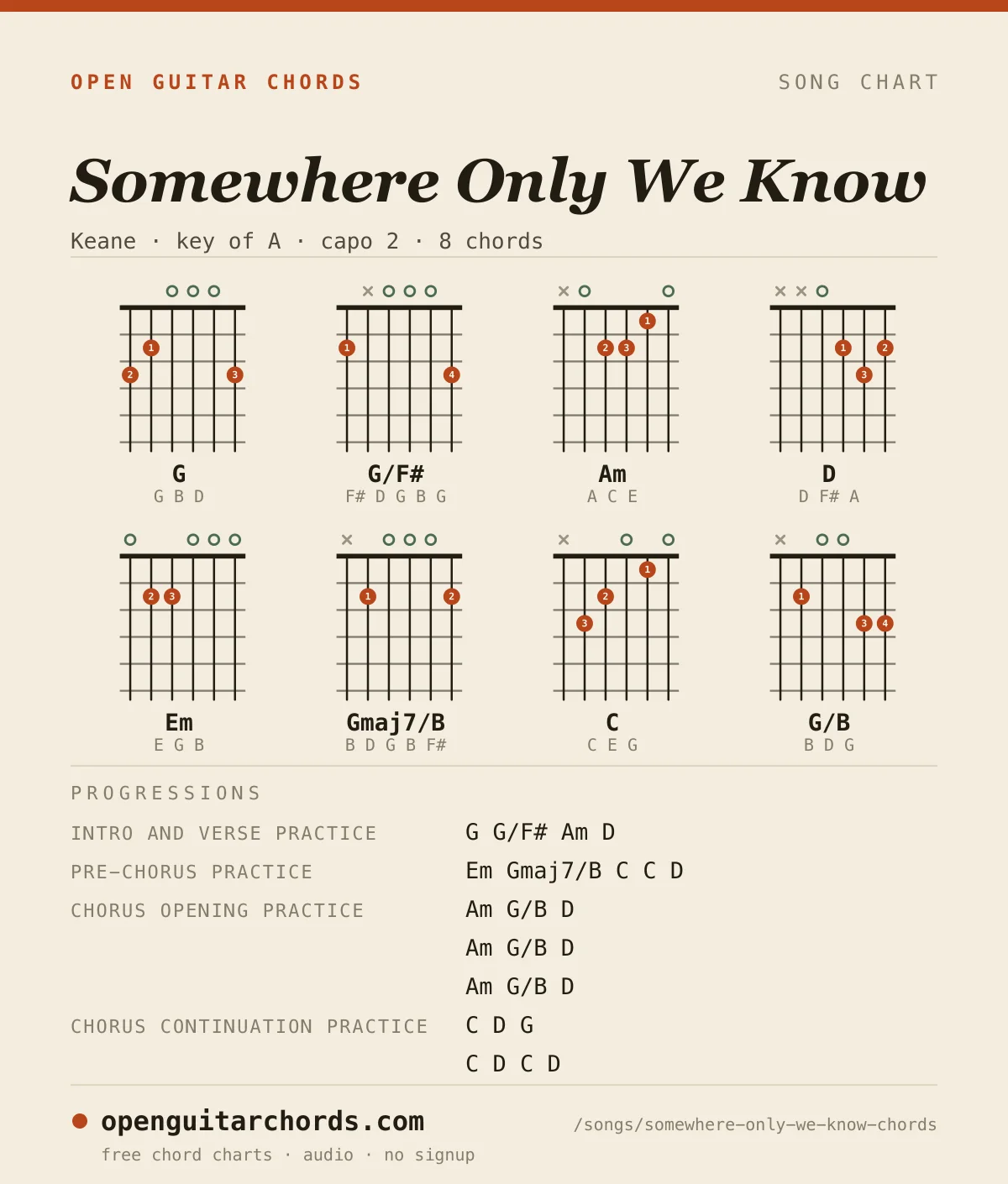
Somewhere Only We Know by Keane is an intermediate song in A, played with a capo on fret 2. The whole sheet is 8 chords (G, G/F#, Am, D, Em, Gmaj7/B, C, G/B) across 4 sections: Intro and verse practice → Pre-chorus practice → Chorus opening practice → Chorus continuation practice. Every shape is an open chord, so nothing here needs barre strength.
Simplified practice arrangement. Section repetitions are practice cues rather than a verified transcription of the recording.
By Chiye · Updated
Hardest change in the sheet: C → D, 4 times.
- Difficulty
- Intermediateno barre needed
- Key
- Awith a capo on fret 2
- Tuning
- Standard (E A D G B E)low to high
- Chords
- 8all open shapes
- Sections
- 4each with its own progression
Chords in Somewhere Only We Know
Frets read low E to high E, x means leave that string out.
Chord sheet
One chord per bar in this practice sheet. Follow the time signature shown beside each section; dots mark the remaining counts in the bar. Tap a bar to hear its chord, or loop the section to practise the changes.
Chord accompaniment only. Follow the section notes for this arrangement’s timing. Songs whose words are public domain →
Intro and verse practice4/4 · ♩=72
Pre-chorus practice4/4 · ♩=72
Chorus opening practice4/4 · ♩=72
Chorus continuation practice4/4 · ♩=72
Printable one-page chord chart
How to play Somewhere Only We Know
Play Somewhere Only We Know by Keane with G-family shapes and capo 2 in standard tuning. These shapes sound in A. The exercises keep the descending verse bass, the added G in the pre-chorus grip and the G/B change in the chorus. Every chord entry is expanded into a four-beat practice bar at 72 BPM, so the exercises provide room for the hand movements rather than the recording’s precise bar lengths.
Choose Keane’s song and the capo-2 setup
Keane’s official music catalogue identifies Somewhere Only We Know as a single released on 16 February 2004. This page follows a guitar arrangement of that song’s piano accompaniment. A different cover can change the pitch, pulse or accompaniment, so match the artist and version before comparing chord names.
At capo 2, G sounds as A, Am as Bm, D as E, Em as F#m and C as D. The slash chords rise by the same two semitones: G/F# sounds as A/G#, and G/B as A/C#. Place the capo behind fret 2, check tuning and read every diagram from that new starting point. Removing the capo while keeping these shapes lowers the accompaniment to G; the key field remains a description of the selected capo-2 version.
Let the verse bass descend from G to F#
The first exercise moves G–G/F#–Am–D. The G/F# grip is 2-x-0-0-0-3. Play the sixth-string second fret as the lowest note and mute string 5; the open middle strings belong to the intended voicing. Compare that F# bass with the preceding G before adding four quiet downstrokes per bar.
Do not substitute Bm simply because it contains F#. It would change the upper harmony as well as the bass. Likewise, our full G voicing is not the G5 grip used for some melody-focused demonstrations. This accompaniment exercise leaves out the piano melody, keeping chord tones in the diagrams instead. Start Am on string 5 and D on string 4 so the bass line does not acquire an unintended low open E.
Keep the extra G in the pre-chorus grip
The exercise uses Em–Gmaj7/B–C–C–D. The second grip is x-2-0-0-0-2, giving B, D, G, B and F#. It combines the B-minor chord tones with G. Check the open third string: muting it would remove the added colour that distinguishes this grip from a plain Bm voicing.
JustinGuitar’s Keane lesson discusses this pre-chorus voicing and the capo-2 guitar arrangement. Its final C and D share a bar in the published progression. Here they receive separate complete practice boxes. The two adjacent C boxes are therefore learning holds, not evidence that the recording contains the same expanded bar count. Keep counting steadily through them instead of using the space to reset the rhythm.
Separate the chorus exercise from the song form
The opening chorus exercise repeats Am–G/B–D three times. G/B is x-2-0-0-3-3: its low B connects the fifth-string bass of Am toward the following D chord. It differs from the pre-chorus Gmaj7/B, which has F# and an open B string in the printed grip. Learn the two shapes as separate targets rather than shortening both names to G.
The continuation moves C–D–G, then C–D–C–D. Our boxes stretch changes that can share a bar in the teaching arrangement. The source also notes changes in the final double chorus, so this exercise list does not claim a complete performance route. Use the quiet quarter-note strokes to make each bass and chord quality clear; add a busier strum only after the changes remain steady without the piano melody as a cue.
How to practise Somewhere Only We Know
Four steps computed from this sheet: the order the shapes are easiest to learn in, the changes that really occur in the progressions above, where each chord turns up, and the tempo ladder up to the speed marked here.
Learn the shapes easiest first
G (3-2-0-0-0-3, beginner) → G/F# (2-x-0-0-0-3, beginner) → Am (x-0-2-2-1-0, beginner) → D (x-x-0-2-3-2, beginner) → Em (0-2-2-0-0-0, beginner) → Gmaj7/B (x-2-0-0-0-2, beginner) → C (x-3-2-0-1-0, beginner) → G/B (x-2-0-0-3-3, beginner)
8 of the 8 shapes are open chords, so nothing here needs barre strength yet.
Drill the changes this sheet actually uses
C → D4×Am → G/B3×G/B → D3×Am → D1×
These counts come from the progressions on this page, so they are the changes you will actually play, not a generic list of pairs to practise.
Know where each chord turns up
- GIntro and verse practice, Chorus continuation practice
- G/F#Intro and verse practice
- AmIntro and verse practice, Chorus opening practice
- Devery section
- EmPre-chorus practice
- Gmaj7/BPre-chorus practice
- CPre-chorus practice, Chorus continuation practice
- G/BChorus opening practice
Climb the tempo ladder
This sheet does not list a tempo, so pick one where every change is clean and use the metronome to move up in 4 BPM steps.
Practise each section's chord changes slowly, then play the sheet through at a steady tempo without pausing between sections.
Playing Somewhere Only We Know with a capo
This sheet is written with a capo on fret 2. Each card shows what you would finger at that capo position so the song still sounds exactly as written. Useful when the shapes above are awkward, or when you want to sing it higher without learning new chords.
No capo
A A* Bm E F#m Amaj7* D A/C#
6 of 8 stay open
Fret 1
Ab Ab* Bbm Eb Fm Abmaj7* C# Ab*
no open shapes left, all barre
Fret 2as written
G G/F# Am D Em Gmaj7/B C G/B
8 of 8 stay open
Fret 3
F# F#* Abm C# Ebm F#maj7* B F#*
no open shapes left, all barre
Fret 4
F F* Gm C Dm Fmaj7* Bb F/A
3 of 8 stay open
Fret 5
E E* F#m B C#m Emaj7* A E*
4 of 8 stay open
Fret 6
Eb Eb* Fm Bb Cm Ebmaj7* Ab Eb*
no open shapes left, all barre
Fret 7
D D* Em A Bm Dmaj7* G D*
6 of 8 stay open
* this position has no separate fingering for a bass-note inversion in our chord library, so the parent chord is shown. Play that shape and the inversion note is an optional bass addition.
Working out a different key? The capo calculatordoes the same arithmetic for any chord set.
More songs built on the same chords
If Somewhere Only We Know clicks, these use the closest set of shapes, so the chords you just learned keep working.
More intermediate songs to learn after this one: Father and Son, 500 Miles, Shallow, The One That Got Away.
These chords across the songbookHow often each chord in Somewhere Only We Know turns up across all 104 songs on this site, and what it most often moves to next. The counts come from the sheet library itself, not from theory.
509bars of this chord across the songbook
77songs use this shape
Most often followed by D, 89×.
1bars of this chord across the songbook
1songs use this shape
Most often followed by Am, 1×.
125bars of this chord across the songbook
35songs use this shape
Most often followed by F, 23×.
323bars of this chord across the songbook
58songs use this shape
Most often followed by G, 52×.
155bars of this chord across the songbook
43songs use this shape
Most often followed by C, 27×.
1bars of this chord across the songbook
1songs use this shape
Most often followed by C, 1×.
420bars of this chord across the songbook
70songs use this shape
Most often followed by G, 115×.
12bars of this chord across the songbook
4songs use this shape
Most often followed by C, 4×.