Elton John
Your Song chords
Your Song by Elton John is an intermediate song in Eb, played with a capo on fret 1. The whole sheet is 9 chords (D, G, A, F#m, Bm, Bm/A, Bm/G#, Em7, Em) across 6 sections: Intro → Verse A → Verse B → Chorus 1 → Chorus 2 → Coda. 7 of the 9 shapes are open chords. Shapes that use a barre: F#m, Bm.
Simplified practice arrangement. Section repetitions are practice cues rather than a verified transcription of the recording.
By Chiye · Updated
Hardest change in the sheet: F#m → Bm, 2 times.
- Difficulty
- Intermediatebarre shape F#m
- Key
- Ebwith a capo on fret 1
- Tuning
- Standard (E A D G B E)low to high
- Chords
- 97 open, 2 with a barre
- Sections
- 69 steps in the song form
Chords in Your Song
Frets read low E to high E, x means leave that string out.
Chord sheet
One chord per bar in this practice sheet. Follow the time signature shown beside each section; dots mark the remaining counts in the bar. Tap a bar to hear its chord, or loop the section to practise the changes.
Chord accompaniment only. Follow the section notes for this arrangement’s timing. Songs whose words are public domain →
Intro4/4 · ♩=60
Verse A4/4 · ♩=60
Verse B4/4 · ♩=60
Chorus 14/4 · ♩=60
Chorus 24/4 · ♩=60
Coda4/4 · ♩=60
Printable one-page chord chart
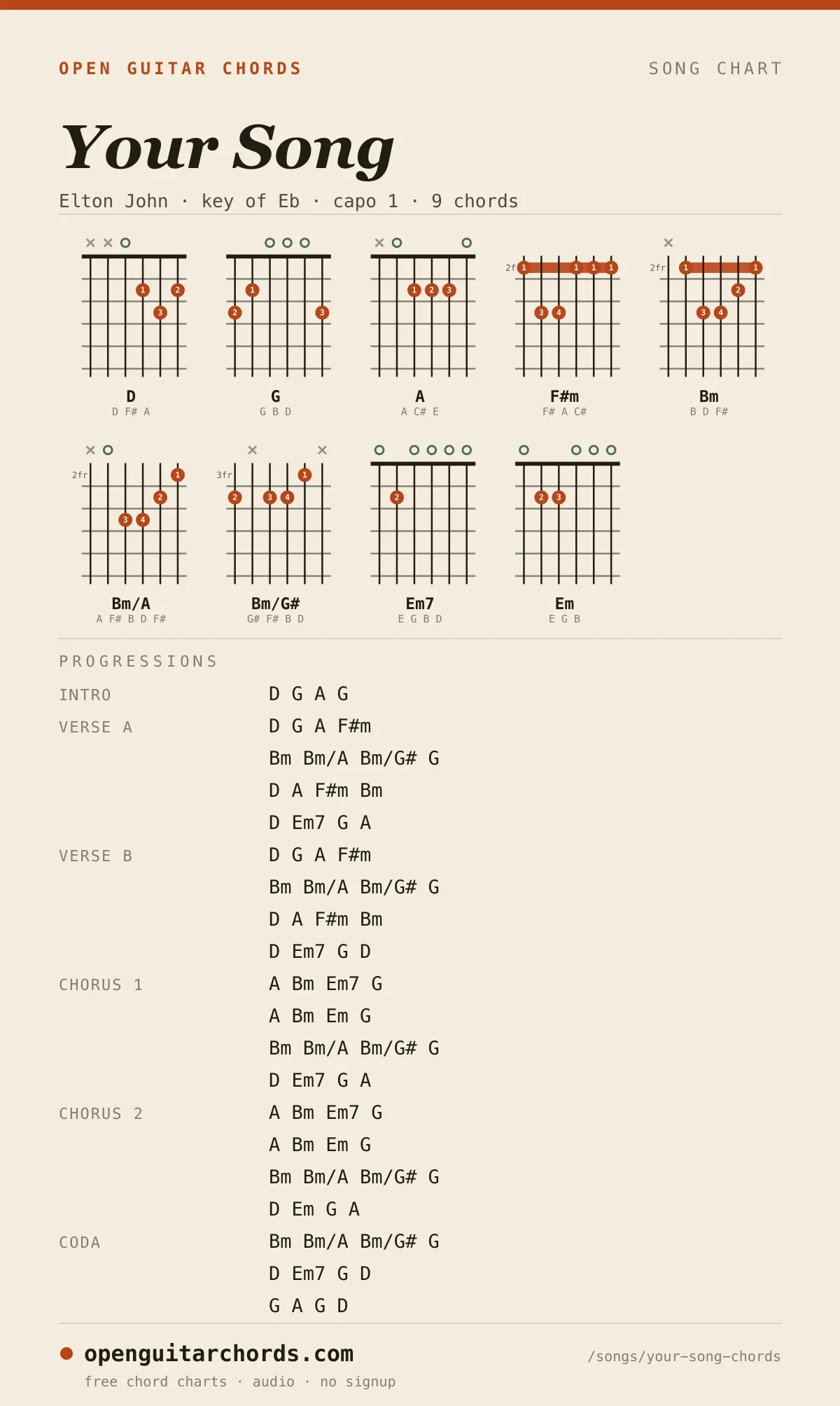
How to play Your Song
Play Your Song by Elton John with D-family shapes and capo 1 in standard tuning. The accompaniment sounds in Eb. This simplified guitar arrangement keeps the descending bass and provides the complete section route from a teacher’s chart. Every box is expanded into a four-beat practice hold at 60 BPM; use those holds to learn the changes before following the original piano’s faster changes within a bar.
Match the D shapes to the sounding key
D, G and A shapes sound as Eb, Ab and Bb with the capo at fret 1. F#m becomes Gm, Bm becomes Cm, and Em7 becomes Fm7. Treat the capo as the nut when reading the diagrams. A second-fret note in a shape is physically at fret 3, while an open string is stopped by the capo at fret 1.
Carl Brown’s guitar lesson explains the standard-tuning setup and the capo needed to raise its open-position arrangement into the original key. Starting without a capo is useful for learning the hand movements, but it sounds a semitone lower. Retune after fitting the capo if the bass strings have been pulled sharp; extra clamping pressure is not a substitute for a cleanly seated capo.
Keep the descending bass audible
The central change is Bm–Bm/A–Bm/G#–G. In the diagrams the lowest notes are B, A, G# and G. At capo 1 they sound as C, Bb, A and Ab. The slash chord names tell you which note should be lowest; they do not ask you to play two separate full chords at once.
For Bm/A, release the fifth-string second fret while retaining the upper minor grip. The open fifth string must ring. For Bm/G#, move to 4-x-4-4-3-x and mute strings 5 and 1. Sound the bass alone before brushing the upper strings. Replacing every symbol with ordinary Bm preserves some upper notes but removes the descent that makes this passage distinctive. Do not let the muted fifth string accidentally sound an A under the G# chord.
Follow both verse endings through the form
The form reads Intro, Verse A, Verse B, Chorus 1, Intro, Verse A, Verse B, Chorus 2, Coda. The second Intro is the interlude using the same chord material. This route and the simplified chord choices come from Relax and Learn Guitar’s Your Song chart. Our A and B labels distinguish the two verse units printed together there.
Verse A ends D–Em7–G–A; Verse B changes that last A to D. The shared opening can make it tempting to repeat the first ending automatically. Practise the last four boxes of each unit separately and say the final chord before playing it. The coda revisits the descending bass, then returns through D, G and A to its final D shape. The section route is complete even though the player’s equal-length boxes deliberately slow down the harmony.
Separate bass placement from fingerpicking detail
Begin with the four downstrokes shown in each eight-slot grid. The empty positions are the eighth-note spaces between quarter-note strokes. Choose the lowest written string for the first attack: string 4 for D, string 5 for Bm and string 6 for Bm/G#. This makes the movement audible before you attempt a fuller accompaniment.
The chorus exercises include both Em7 and Em; the second chorus also uses Em in its final line. Listen for the extra D in Em7 rather than assuming the longer name is cosmetic. Keep F#m and Bm light enough to move without squeezing continuously. Once every bass note arrives on time, try a quiet bass attack followed by upper chord tones of your own choosing. The exercises do not transcribe the piano melody or prescribe its exact fingerpicking pattern.
How to practise Your Song
Four steps computed from this sheet: the order the shapes are easiest to learn in, the changes that really occur in the progressions above, where each chord turns up, and the tempo ladder up to the speed marked here.
Learn the shapes easiest first
D (x-x-0-2-3-2, beginner) → G (3-2-0-0-0-3, beginner) → A (x-0-2-2-2-0, beginner) → Bm/A (x-0-4-4-3-2, beginner) → Bm/G# (4-x-4-4-3-x, beginner) → Em7 (0-2-0-0-0-0, beginner) → Em (0-2-2-0-0-0, beginner) → F#m (2-4-4-2-2-2, intermediate, needs a barre) → Bm (x-2-4-4-3-2, intermediate, needs a barre)
7 of the 9 shapes are open chords, so start there and leave F#m until the others change cleanly.
Drill the changes this sheet actually uses
G → A7×Em7 → G6×Bm → Bm/A5×Bm/A → Bm/G#5×
These counts come from the progressions on this page, so they are the changes you will actually play, not a generic list of pairs to practise.
Know where each chord turns up
- Devery section
- Gevery section
- Aevery section
- F#mVerse A, Verse B
- BmVerse A, Verse B, Chorus 1, Chorus 2, Coda
- Bm/AVerse A, Verse B, Chorus 1, Chorus 2, Coda
- Bm/G#Verse A, Verse B, Chorus 1, Chorus 2, Coda
- Em7Verse A, Verse B, Chorus 1, Chorus 2, Coda
- EmChorus 1, Chorus 2
Climb the tempo ladder
This sheet does not list a tempo, so pick one where every change is clean and use the metronome to move up in 4 BPM steps.
Practise each section's chord changes slowly, then play the sheet through at a steady tempo without pausing between sections.
Playing Your Song with a capo
This sheet is written with a capo on fret 1. Each card shows what you would finger at that capo position so the song still sounds exactly as written. Useful when the shapes above are awkward, or when you want to sing it higher without learning new chords.
No capo
Eb Ab Bb Gm Cm Cm* Cm* Fm7 Fm
no open shapes left, all barre
Fret 1as written
D G A F#m Bm Bm/A Bm/G# Em7 Em
7 of 9 stay open
Fret 2
C# F# Ab Fm Bbm Bbm* Bbm* Ebm7 Ebm
no open shapes left, all barre
Fret 3
C F G Em Am Am/G Am* Dm7 Dm
7 of 9 stay open
Fret 4
B E F# Ebm Abm Abm* Abm* C#m7 C#m
1 of 9 stay open
Fret 5
Bb Eb F Dm Gm Gm* Gm* Cm7 Cm
1 of 9 stay open
Fret 6
A D E C#m F#m F#m* F#m* Bm7 Bm
4 of 9 stay open
Fret 7
Ab C# Eb Cm Fm Fm* Fm* Bbm7 Bbm
no open shapes left, all barre
* this position has no separate fingering for a bass-note inversion in our chord library, so the parent chord is shown. Play that shape and the inversion note is an optional bass addition.
Working out a different key? The capo calculatordoes the same arithmetic for any chord set.
More songs built on the same chords
If Your Song clicks, these use the closest set of shapes, so the chords you just learned keep working.
More intermediate songs to learn after this one: Father and Son, 500 Miles, The One That Got Away, Treat You Better.
These chords across the songbookHow often each chord in Your Song turns up across all 104 songs on this site, and what it most often moves to next. The counts come from the sheet library itself, not from theory.
323bars of this chord across the songbook
58songs use this shape
Most often followed by G, 52×.
509bars of this chord across the songbook
77songs use this shape
Most often followed by D, 89×.
134bars of this chord across the songbook
24songs use this shape
Most often followed by D, 19×.
13bars of this chord across the songbook
6songs use this shape
Most often followed by D, 4×.
84bars of this chord across the songbook
17songs use this shape
Most often followed by A, 13×.
5bars of this chord across the songbook
1songs use this shape
Most often followed by Bm/G#, 5×.
5bars of this chord across the songbook
1songs use this shape
Most often followed by G, 5×.
31bars of this chord across the songbook
6songs use this shape
Most often followed by G, 13×.
155bars of this chord across the songbook
43songs use this shape
Most often followed by C, 27×.