Guitar scale
C# natural minor scale (Db natural minor)
The C# natural minor scale is the darker mirror of the major scale, and the home sound of rock ballads, folk and minor-key pop. Best for ballads, rock, minor-key pop.
- Root
- C#
- Notes
- C#D#EF#G#AB
- Formula
- W-H-W-W-H-W-W
- Relative key
- E major
- Learning path
- Step 4 of 5
Print or save the C# natural minor chart
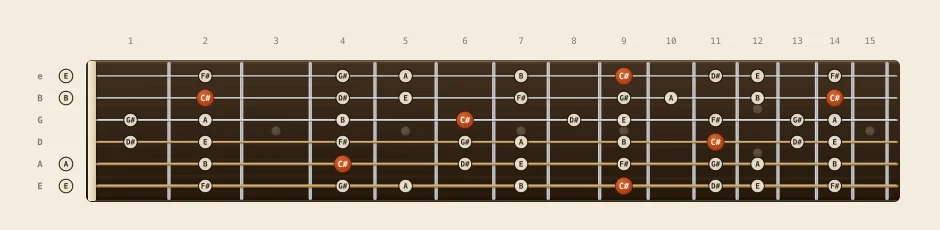
940 × 230 px version of the chart above, sized for a phone screen or a printed handout. Tap the image to save it.
The C# natural minor scale is the seven notes C#, D#, E, F#, G#, A and B. Read as scale degrees from C#, that is 1, 2, ♭3, 4, 5, ♭6, ♭7. Every note is a fixed distance from the one before it: W-H-W-W-H-W-W, where W is a whole step (2 frets) and H is a half step (1 fret). That pattern is the whole scale. Move it so the root lands on a different note and you are playing that key's natural minor scale. The scale supplies the chords of its key: C#m (i), D#dim (ii°), E (III), F#m (iv), G#m (v), A (VI), B (VII). Its relative key is E major, which uses exactly the same notes. What changes is the note that feels like home. On the guitar this is not one shape but overlapping positions: the lowest C# sits at fret 2 on the B string.
Start here: one C# natural minor position
The notes inside frets 2 to 6 sit in the highlighted box above. The diagram below isolates that position and numbers the run to play. Learn this box first; other positions contain the same scale notes with different fingerings.
Play the box in this order
C# 1 → D# 2 → E ♭3 → F# 4 → G# 5 → A ♭6 → B ♭7
Plays exactly the run numbered above, one note at a time.
Every C# on the neck
What notes are in the C# natural minor scale?
- C#1Root
- W
- D#2Major 2nd
- H
- E♭3Minor 3rd
- W
- F#4Perfect 4th
- W
- G#5Perfect 5th
- H
- A♭6Minor 6th
- W
- B♭7Minor 7th
- W
- C#1octave
W whole step (2 frets), H half step (1 fret). The same pattern from any other root gives that key's natural minor scale.
Chords in the key of C# natural minor
Every chord below is built from the notes of this scale, so a song in C# natural minor uses almost nothing else. Together they account for 228 chord changes in the library, counted, not estimated.
How to practise the C# natural minor scale
- Frets 2 to 6, slowly. The position above, up and back, naming every note out loud. Naming is what turns a shape into a scale.
- Then find the next C#: low E string, fret 9. Use the full neck diagram to find the scale notes around that root. Play root to root at 60 BPM, one note per beat; fingerings change when you move to a different string set.
- Then stop counting. Improvise on these notes for two minutes over any backing track in C#m / Dbm. That is what the scale is for.
What the library actually plays in C# natural minorCounted from the progressions written out in the song sheets charted here, not derived from theory. Only three-chord runs that stay inside the C# natural minor scale are shown.
- Run #1
- E → Am → Eplayed 6 times
- Run #2
- E → E → Aplayed 4 times
- Run #3
- A → Bm → Bmplayed 4 times
C# natural minor scale: common questions
What notes are in the C# natural minor scale?
What is the formula for the C# natural minor scale?
What chords are in the key of C# natural minor?
Is the C# natural minor scale the same as E major?
What is the easiest fingering for the C# natural minor scale?
How do I practise the C# natural minor scale?
More C# scales
This scale in other keys