Guitar scale
D natural minor scale
The D natural minor scale is the darker mirror of the major scale, and the home sound of rock ballads, folk and minor-key pop. Best for ballads, rock, minor-key pop.
- Root
- D
- Notes
- DEFGABbC
- Formula
- W-H-W-W-H-W-W
- Relative key
- F major
- Learning path
- Step 4 of 5
Print or save the D natural minor chart
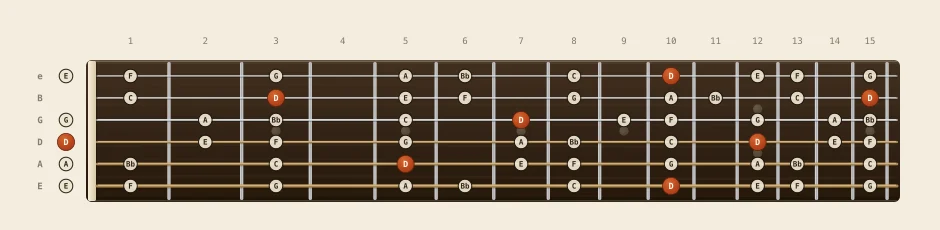
940 × 230 px version of the chart above, sized for a phone screen or a printed handout. Tap the image to save it.
The D natural minor scale is the seven notes D, E, F, G, A, Bb and C. Read as scale degrees from D, that is 1, 2, ♭3, 4, 5, ♭6, ♭7. Every note is a fixed distance from the one before it: W-H-W-W-H-W-W, where W is a whole step (2 frets) and H is a half step (1 fret). That pattern is the whole scale. Move it so the root lands on a different note and you are playing that key's natural minor scale. The scale supplies the chords of its key: Dm (i), Edim (ii°), F (III), Gm (iv), Am (v), Bb (VI), C (VII). Its relative key is F major, which uses exactly the same notes. What changes is the note that feels like home. On the guitar this is not one shape but overlapping positions: the lowest D sits at fret 0 on the D string. 2 of the 80 song sheets charted here are in Dm.
Start here: one D natural minor position
Every note of the scale inside frets 0 to 4 sits in the box highlighted on the full neck above. The diagram below is that box on its own, numbered in the order to play it. Learn this one box first; the rest of the neck is the same shape repeated.
Play the box in this order
D 1 → E 2 → F ♭3 → G 4 → A 5 → Bb ♭6 → C ♭7
Plays exactly the run numbered above, one note at a time.
Every D on the neck
What notes are in the D natural minor scale?
- D1Root
- W
- E2Major 2nd
- H
- F♭3Minor 3rd
- W
- G4Perfect 4th
- W
- A5Perfect 5th
- H
- Bb♭6Minor 6th
- W
- C♭7Minor 7th
- W
- D1octave
W whole step (2 frets), H half step (1 fret). The same pattern from any other root gives that key's natural minor scale.
Chords in the key of D natural minor
Every chord below is built from the notes of this scale, so a song in D natural minor uses almost nothing else. Together they account for 604 chord changes in the library, counted, not estimated.
How to practise the D natural minor scale
- Frets 0 to 4, slowly. The position above, up and back, naming every note out loud. Naming is what turns a shape into a scale.
- Then find the next D: A string, fret 5. Build the same shape from there and play root to root at 60 BPM, one note per beat.
- Then stop counting. Pick a song in Dm from the list below and improvise on these notes for two minutes. That is what the scale is for.
Songs in Dm on this site
2 of the 80 song sheets charted here are in Dm. Play this scale over any of them and every note lands inside the key.
What the library actually plays in D natural minorCounted from the progressions written out in the song sheets charted here, not derived from theory. Only three-chord runs that stay inside the D natural minor scale are shown.
- Run #1
- C → G → Dplayed 34 times
- Run #2
- C → G → Cplayed 26 times
- Run #3
- F → C → Gplayed 24 times
D natural minor scale: common questions
What notes are in the D natural minor scale?
What is the formula for the D natural minor scale?
What chords are in the key of D natural minor?
Is the D natural minor scale the same as F major?
What is the easiest fingering for the D natural minor scale?
How do I practise the D natural minor scale?
More D scales
This scale in other keys