Chord progression generator
Pick a key and a proven pattern, hear it strummed, then open every chord diagram in the loop.
- keys
- 12 major, 12 minor
- patterns
- 6 major, 4 minor
- diatonic chords
- 7 per key
- audio
- Web Audio
How to use generated progressions
A generated loop is a starting point, not a song. These four moves turn four roman numerals into something you can actually play.
- Loop it slowly. Play one strum per chord with themetronome at 70 BPM until the changes are automatic. The pattern should feel like one gesture, not four separate chords.
- Hum a melody on top. The progression is the floor; the melody is the song. Loop the chords and hum nonsense syllables until something sticks.
- Transpose it for your voice. Too high to sing? Change the key above and the pattern stays identical while the chords move. Thecapo calculator finds the easiest shapes for the new key.
- Check it against a real song. Open a sheet from the list above, or run its chords through the key finder, and you will see the same numerals doing the same jobs in a song people already know.
What is a chord progression generator?
A chord progression generator is a tool that builds a chord sequence for you instead of making you guess one chord at a time. You choose a key, and every pattern it offers is written in roman numerals: I, IV, V, vi and the rest. Numerals describe the job each chord does inside the key rather than the letter name, so one pattern works in all twelve keys. Pick I-V-vi-IV in C and the tool plays C, G, Am, F. Switch the key to G and the same pattern becomes G, D, Em, C without changing a single thing about how it feels. Because the output is plain chords, you can hear the loop strummed, open the diagram for any chord in it, transpose the whole progression for a singer, and copy the symbols into a lyric sheet or a rehearsal note.
Learn & referenceExamples, charts and deeper explanation
The seven diatonic chords, and what each one does
Stack a note, its third and its fifth on every step of the major scale and you get seven chords, no more and no less. The pattern of qualities is identical in every key, which is why the numerals travel: in C major the seven chords are spelled out below.
| Degree | In C major | Quality | What it does in a progression |
|---|---|---|---|
| I | C | major | Home. The tonic, where a progression starts and wants to finish. |
| ii | Dm | minor | Gentle forward motion. Softens the step into V. |
| iii | Em | minor | Quiet colour. Often stands in for I, and bridges into vi. |
| IV | F | major | Departure. The chord that makes the key feel wide open. |
| V | G | major | Tension. The strongest pull back home to I. |
| vi | Am | minor | The relative minor. Adds melancholy without leaving the key. |
| vii° | Bdim | diminished | Instability. Rare on its own, usually a passing chord into I. |
Lowercase numerals are minor chords and the small circle marks a diminished one, so vi is A minor and vii° is B diminished. The full dictionary lives in thechord chart.
The four chords behind I-V-vi-IV
The most used progression in pop needs three open shapes and one barre. These are the real fingerings this generator plays when you leave it in C major.
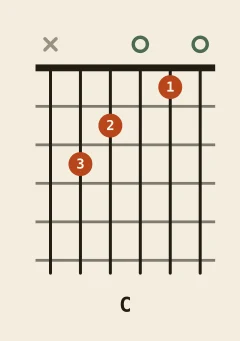
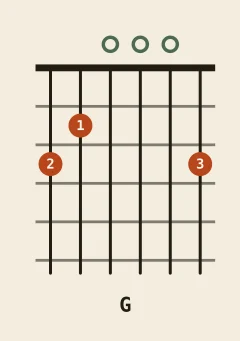
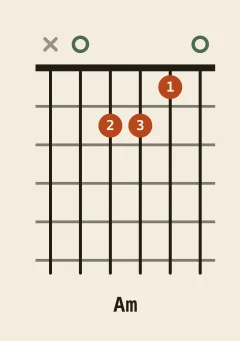
Real songs, and the pattern inside them
Every sheet in the songbook prints its sections chord by chord, so you can check a loop against the record before you learn it. These eight songs are the patterns above in the wild.
Want to know why those songs sit together? The chord progressions guide walks through the same numerals in longer form, and thecircle of fifths shows which chords belong to a key at a glance.
Chord progression FAQ
What is a chord progression?
Why do so many songs use I-V-vi-IV?
How do I write my own progression?
Do the progressions work in a minor key?
New to the shapes themselves? Start with thebasic guitar chords guide or thefull chord dictionary.