4 Non Blondes
What's Up? chords
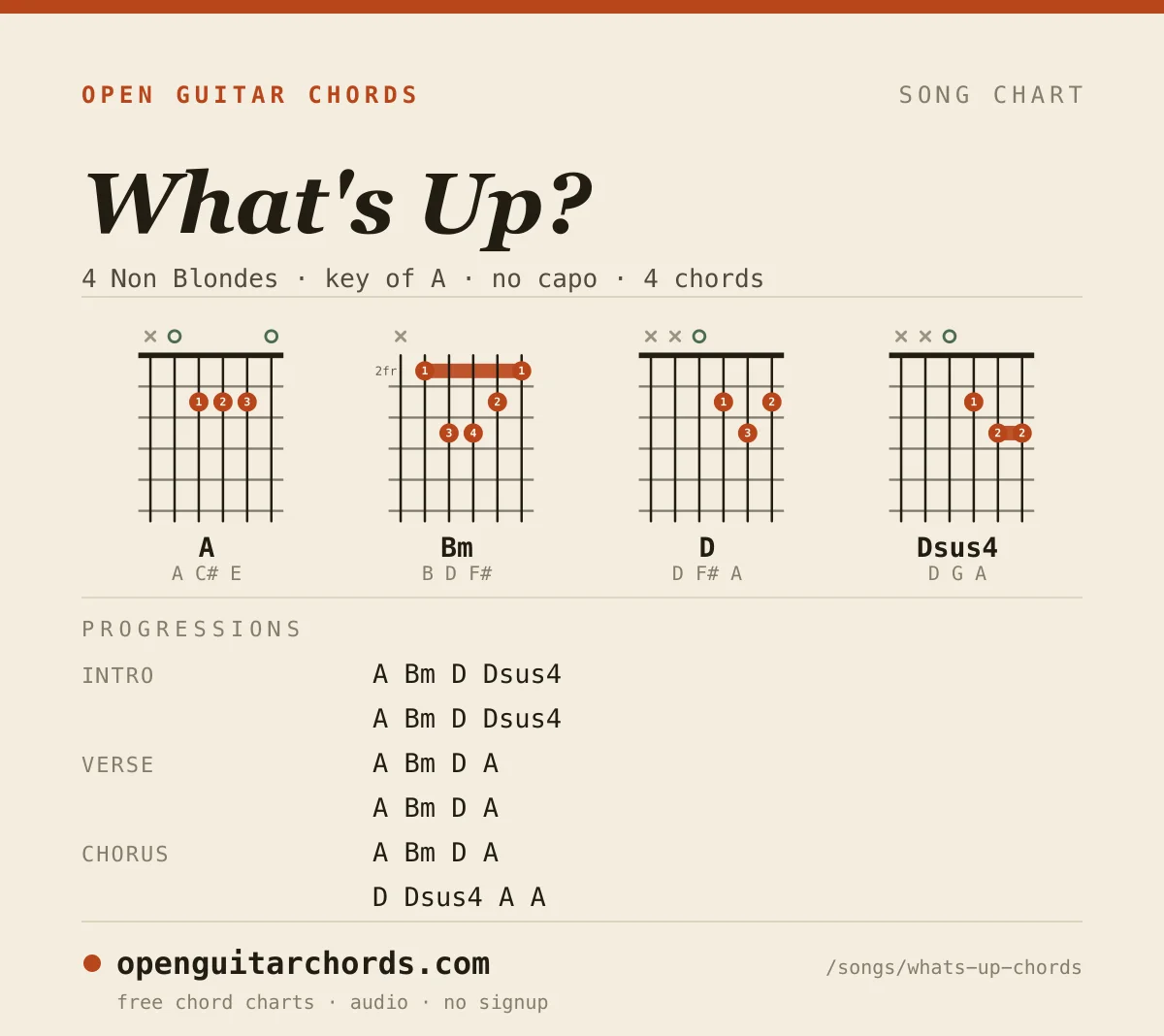
What's Up? by 4 Non Blondes is a beginner song in A, played with no capo. The whole sheet is 4 chords (A, Bm, D, Dsus4) across 3 sections: Intro → Verse → Chorus. 2 of the 4 shapes are open chords and Bm is the one that needs a barre. It sits at roughly 134 BPM.
By Chiye · Updated
Hardest change in the sheet: A → Bm, 5 times.
- Difficulty
- Beginnerbarre shape Bm
- Key
- Awith no capo
- Tempo
- 134BPM
- Tuning
- Standard (E A D G B E)low to high
- Chords
- 42 open, 2 with a barre
- Sections
- 3each with its own progression
Chords in What's Up?
Frets read low E to high E, x means leave that string out.
Chord sheet
One chord per bar, four beats to the bar: the shape lands on beat one and the dots mark the beats after it, so you can see where the change falls without any lyrics. Where a section has no strumming pattern written, play one chord per bar. Tap a bar to hear it.
Lyrics are not reproduced for this song: they are still in copyright and this site has no licence to publish them. The chords, structure, strumming and sing-along timing are all here. Songs whose words are public domain →
Intro♩=134
Verse♩=134
Chorus♩=134
Printable one-page chord chart
How to play What's Up?
Three chords carry the whole song and one gesture carries the sound: A, Bm, D, back to A, four beats each, repeating from the first bar to the last. The only thing that changes between the verse and the chorus is how hard you hit it. Practise the loop at 100 BPM with straight downstrokes on every beat, no upside-down strumming at all, and let the low A string ring for its full beat before the Bm arrives.
Bm is the hard one for most players because it needs a barre at the 2nd fret or a four-string version that skips the low E. Take the small shape on the D, G, B and high E strings and mute the low E with the side of your index finger. Keep the index finger flat and the wrist slightly forward. The change from A to Bm is the entire difficulty of this song, so drill it alone: four beats of A, four of Bm, sixty times with the metronome at 90, no strumming hand involved.
Dsus4 appears in the intro and as the lift into the last line of the chorus. It is a D shape with the little finger planted on the high E string at the 3rd fret, so do not rebuild your hand, just drop the finger. Play D for three beats and hold Dsus4 for the fourth one; the suspension pulls your ear forward into the next A. Release the little finger as you change, not after.
The record sits around 134 BPM and gets very loud in the second half, which is a trap: beginners speed up rather than strum harder. Set the metronome to 118 and play the full Chorus twice, then the Verse twice, at one constant volume, before you allow yourself any dynamics. Singing while playing only works once the A to Bm change no longer needs your eyes.
How to practise What's Up?
Four steps computed from this sheet: the order the shapes are easiest to learn in, the changes that really occur in the progressions above, where each chord turns up, and the tempo ladder up to the recorded speed.
Learn the shapes easiest first
A (x-0-2-2-2-0, beginner) → D (x-x-0-2-3-2, beginner) → Bm (x-2-4-4-3-2, intermediate, needs a barre) → Dsus4 (x-x-0-2-3-3, intermediate, needs a barre)
2 of the 4 shapes are open chords, so start there and leave Bm until the others change cleanly.
Drill the changes this sheet actually uses
A → Bm5×Bm → D5×D → A3×D → Dsus43×
These counts come from the progressions on this page, so they are the changes you will actually play, not a generic list of pairs to practise.
Know where each chord turns up
- Aevery section
- Bmevery section
- Devery section
- Dsus4Intro, Chorus
Climb the tempo ladder
Start at 80 BPM and move up only when a full pass is clean: 80 → 101 → 121 → 134 BPM. The recorded feel is around 134 BPM, and the last step is the one that always feels like a jump. Stay at 121 for longer than feels necessary.
Every section here uses the same set of shapes, so there is no section to single out. Whatever you can play once, you can play all the way through.
Playing What's Up? with a capo
This sheet needs no capo. Each card shows what you would finger at that capo position so the song still sounds exactly as written. Useful when the shapes above are awkward, or when you want to sing it higher without learning new chords.
No capoas written
A Bm D Dsus4
2 of 4 stay open
Fret 1
Ab Bbm C# C#sus4
no open shapes left, all barre
Fret 2
G Am C Csus4
4 of 4 stay open
Fret 3
F# Abm B Bsus4
no open shapes left, all barre
Fret 4
F Gm Bb Bbsus4
no open shapes left, all barre
Fret 5
E F#m A Asus4
3 of 4 stay open
Fret 6
Eb Fm Ab Absus4
no open shapes left, all barre
Fret 7
D Em G Gsus4
4 of 4 stay open
Working out a different key? The capo calculatordoes the same arithmetic for any chord set.
More songs built on the same chords
If What's Up? clicks, these use the closest set of shapes, so the chords you just learned keep working.
More beginner songs to learn after this one: Wonderwall, Let It Be, Creep, Hallelujah.
These chords across the songbookHow often each chord in What's Up? turns up across all 80 songs on this site, and what it most often moves to next. The counts come from the sheet library itself, not from theory.
120bars of this chord across the songbook
20songs use this shape
Most often followed by D, 24×.
53bars of this chord across the songbook
11songs use this shape
Most often followed by A, 12×.
248bars of this chord across the songbook
44songs use this shape
Most often followed by G, 40×.
18bars of this chord across the songbook
4songs use this shape
Most often followed by A7sus4, 4×.